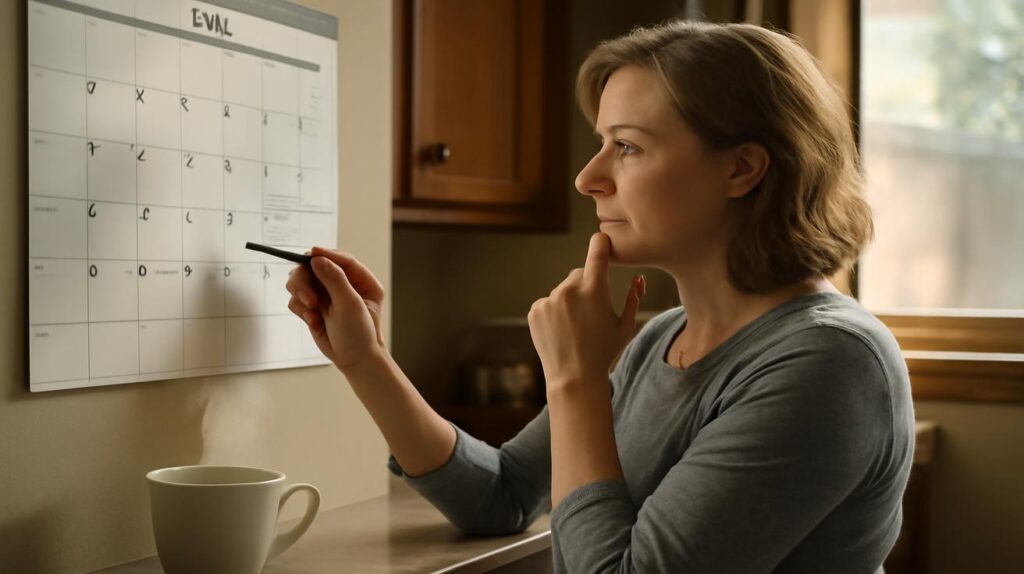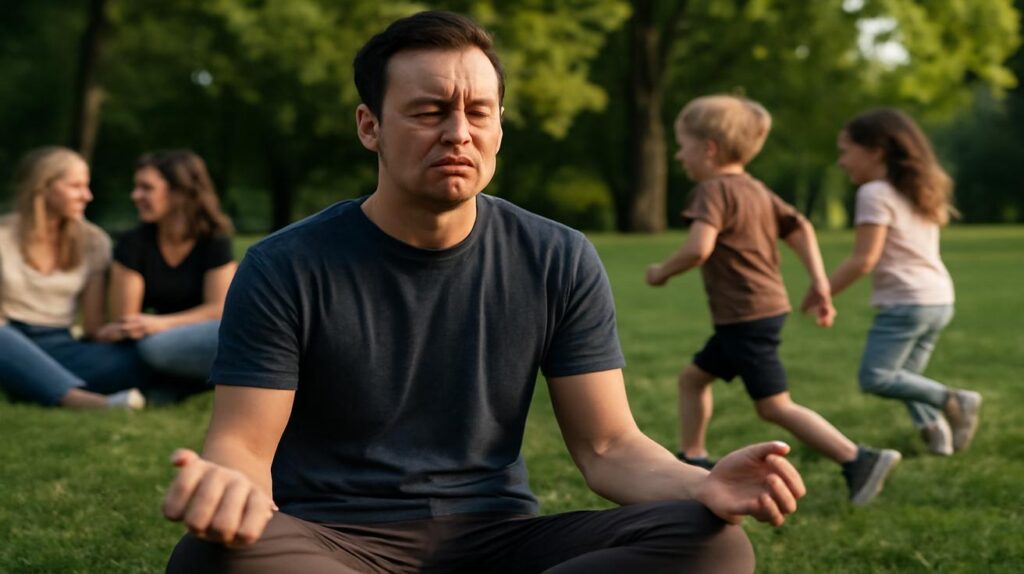
You’re sitting on the floor, spine straight, eyes closed, phone on “Do Not Disturb.” A guided meditation trickles through your earbuds: “Notice your breath… inhale calm… exhale stress…” You try. You really do. Three breaths in, three out—then your mind darts to the email you forgot to send, the friend you never replied to, the awkward thing you said in a meeting four months ago. You notice your breath. You notice your tension. You notice, acutely, how not-calm you are. And in a quiet, guilty corner of your mind, a thought whispers: If mindfulness is supposed to make me feel better… why do I feel worse?
When Paying Attention Turns Into Picking Yourself Apart
The idea sounds so wholesome it’s practically bulletproof: be more present, focus on your breath, write down three things you’re grateful for, repeat. Your life will feel richer, calmer, more meaningful. That’s the promise tucked into meditation apps, yoga studio posters, and the pastel covers of self-help books stacked near the checkout line.
But there’s a version of this story that rarely makes it into the marketing copy. It’s the story of the person who tries all of it—breathing exercises, daily reflection, gratitude challenges—and ends up more anxious, more self-critical, and strangely detached from their own life, like they’re watching themselves from the outside, grading their performance on “being present.”
This is the paradox creeping quietly through a generation convinced that mental wellness is a solo, perfectly optimized project. Mindfulness is not the enemy. But the way we’re practicing it—alone, performance-driven, app-tracked, and relentlessly self-focused—can distort something beautiful into yet another thing we can fail at.
The Invisible Shift: From Living Your Life to Watching It
Imagine you’re laughing with friends at a noisy restaurant. Glasses clink, someone tells a story that makes you snort mid-sip, and for a fleeting moment, you’re not thinking about anything. You’re just there. Present. Alive. No breathing cues, no body scans—just life, happening.
Then, like a tap on the shoulder, a voice in your head speaks up: “This is a good moment. Be mindful. Be grateful. Really savor it.” Suddenly you’re monitoring yourself savoring. A thin layer of glass drops between you and the moment, and you’re on the other side, observing. You’re not just living; you’re evaluating how well you’re living.
This is what psychologists sometimes call self-objectification or observer perspective: when you view yourself as if from the outside. It’s the mental habit of turning your own life into a kind of movie you’re watching and critiquing—except now the movie has a mindfulness score.
And it’s sneaky. You sit in meditation, watching your thoughts like clouds in the sky, which can be wonderfully freeing. But if you’re already anxious, already hyper-aware of your perceived flaws, “watch your thoughts” can morph into “watch yourself failing at controlling your thoughts.” What was meant as gentle noticing becomes a daily appointment with your own inadequacy.
When Mindfulness Becomes Another Way to Prove You’re Broken
For many people, mindfulness isn’t the problem—it’s the context it lands in. Picture someone who has spent years feeling like they’re too much or not enough. Maybe they’re battling depression, chronic loneliness, or just the ambiguous ache of modern life. One day, they read that “mindfulness reduces anxiety and boosts happiness.” Perfect. A fix.
They download a meditation app. Day one, they sit for five minutes and feel like a hero. Day three, their mind is racing and their leg falls asleep. By day ten, they skip a session, get a notification about “keeping your streak alive,” and watch a red number reset to zero. A new narrative takes shape: I can’t even meditate right. I fail at relaxing.
Something designed as non-judgmental awareness quietly mutates into a moral scoreboard. Did you meditate? Did you journal? Did you do your gratitude list? How many days in a row? How many breaths before your mind wandered? The metrics pile up, and with them, the sense that your worth is tied to your wellness performance.
Here’s where the suffering sneaks in: when calm, presence, and positivity become obligations instead of invitations, every anxious thought feels like a personal failure. Instead of easing the pressure, mindfulness culture can turn inner life into a monitored workplace where productivity is measured in serenity and self-acceptance—and you are constantly under review.
The Dark Side of Chasing Positivity
Layered over all this is the bright, relentless glow of positivity culture. Gratitude journals. Affirmation decks. “Good vibes only” hoodies. The message is clear: a good life is a positive life. Grateful. Optimistic. High frequency. Low drama.
Positivity, on its own, is not the villain. Gratitude can rewire attention in beautiful ways. But when positivity is treated like a rule instead of a possibility, something harsh happens in the background: your real, messy, complicated emotions get shoved into a closet and locked away.
Think about the last time you felt something dark: jealousy, rage, grief, numbness, boredom. Now imagine overlaying that feeling with a pressure to “find the silver lining” or “remember how lucky you are.” If the first emotion is hard, the second layer—guilt for having it—is often worse. This is what’s been called toxic positivity: when the demand to think positive makes you feel ashamed for being human.
Here’s the twist: mindfulness, in its original form, was never meant to be a positivity machine. It was about seeing things as they are, not as we wish they were. But in a culture allergic to discomfort, we reach for mindfulness and gratitude as tools to escape pain, not to understand it. And when they don’t instantly work, we assume the flaw is in us.
Lonely in a Room Full of Self-Help
Walk into a bookstore and you’ll find entire walls dedicated to “self-care” and “mindful living.” Scroll online and every other post promises ten ways to regulate your nervous system, heal your inner child, or reset your mindset before breakfast. Paradoxically, the more obsessed we become with curating our inner world, the lonelier many people feel.
There’s a reason for that. Humans don’t get well alone. Our nervous systems are social—wired to regulate not just through slow breaths and gentle thoughts, but through being with other people: sharing food, crying in someone’s arms, laughing at something stupid, feeling seen when we’re at our worst.
Yet much of modern mindfulness is marketed like a solo sport. Put on your headphones, close your door, sit calmly by yourself, and work on your mind the way you might work on your abs. The implicit message: You, alone, are responsible for your peace. If you’re anxious, it’s because you haven’t optimized your inner life enough.
People carry this belief quietly, like a private shame. They meditate, journal, and practice “self-compassion” in isolation—then judge themselves for still needing other people. The result? A subtle, painful disconnection. You can end up more intimate with your thought patterns than with your friends. You know every contour of your trauma history, but your evenings are spent in front of a screen, “checking in with yourself” instead of knocking on a neighbor’s door, calling a sibling, or awkwardly joining a local group you might or might not like.
This inward tilt doesn’t only deepen loneliness; it can narrow your world until all that matters is what’s happening inside your skull. The more you focus on your internal weather, the easier it is to miss the actual world blooming and unraveling around you—the way the light hits the building across the street, the smell of rain on warm pavement, the quiet drama of a stranger’s face on the bus. Mindfulness, ironically, can make life smaller if it never extends beyond your own mind.
Breathing Exercises Are Not a Life Raft for a Sinking Ship
Breathe in for four, hold for four, out for six. Box breathing, belly breathing, alternate nostril breathing—there’s a technique for every taste. These exercises genuinely help. They calm the body’s alarm system, soothe the nervous system, and can keep a panic attack from cresting. They’re powerful tools.
But tools are not foundations. There’s a difference between regulating your body in a stressful moment and outsourcing your entire sense of safety to a ritual. When every difficult situation triggers a frantic “I must do my breathing,” the message underneath is: I can’t handle this without a technique.
Sometimes the anxiety is not a misfire; it’s a signal. No number of calming breaths will fix a job that’s destroying you, a relationship that’s eroding your self-respect, or a culture that keeps you sleepless with economic or social pressure. When techniques are used to endure the unbearable instead of question it, mindfulness stops being liberating and starts being a sedative.
We also rarely talk about how breathing practices can backfire for some people. If you’re prone to panic, turning sharp attention toward your breath can make you hyper-aware of every flutter and sensation, which may actually spike anxiety. For someone with trauma tied to breathing or the body, “just notice your breath” might not be neutral or safe at all.
None of this means “don’t breathe deeply.” It means: if every solution you’re offered is individual and inward—calm your mind, manage your stress, change your thoughts—you might start to blame yourself for pains that are not solely yours to carry. A collapsing social safety net or a harsh, isolating culture cannot be “mindful breathed” away.
Mindfulness Without the Mirror: Turning Attention Back Outward
If the version of mindfulness saturating our feeds and to-do lists can trap us in obsessive self-observation, what does a healthier version look like? Ironically, it may look less like “doing mindfulness” and more like simply being immersed in the world again.
Instead of turning awareness inward all the time, what happens if we practice outward mindfulness? Noticing the way your friend’s voice softens when they’re tired. Watching the pattern of leaves in the wind. Feeling the weight of a ceramic mug in your hand—not as a technique, but as a small act of returning to the scene you’re actually in.
This isn’t about abandoning self-reflection; it’s about balancing it. If you’ve spent months or years monitoring your thoughts, tracking your mood, and writing about your feelings, maybe the next step isn’t more insight. Maybe it’s contact. With people. With places. With work that matters beyond your personal growth.
Mindfulness can be less about “How am I doing right now?” and more about “What is happening right here?” That subtle shift—from self as the main character to self as one part of a larger living world—can loosen the tight knot at the center of self-obsession without numbing you out.
| Common Practice | How It Can Backfire | A Healthier Reframe |
|---|---|---|
| Daily meditation streaks on an app | Turns presence into a performance metric; guilt when you “break the streak.” | Treat meditation as a flexible ritual: some days it’s 2 minutes, some days a walk without headphones. |
| Gratitude journaling every night | Pressure to feel thankful even when you’re grieving or angry; shame for “negative” emotions. | Allow mixed lists: “What hurt today” and “What helped today” both get space on the page. |
| Breathing exercises during every discomfort | Can become avoidance of necessary conflict or change; reinforces “I can’t cope without tools.” | Use breathing to ground yourself, then ask: “Is there a boundary I need to set or a change I must make?” |
| Constant self-monitoring of thoughts and feelings | Intensifies anxiety; life feels like a project under constant inspection. | Set “off-duty” times from self-analysis: cooking with music on, playing, engaging in shared activities. |
| Using mindfulness to “fix” yourself | Reinforces the belief that you are broken and must be optimized. | Approach with curiosity, not repair: “What’s it like to be me today?” instead of “How do I upgrade me?” |
Making Space for the Full Weather of Being Human
There’s a quieter, more honest version of all these practices that doesn’t demand constant positivity or flawless calm. It doesn’t turn you into a spectator of your life, endlessly commenting from the sidelines. It invites you back onto the field—mud, sweat, heartbreak and all.
Instead of trying to breathe your way out of every difficult feeling, you might experiment with simply letting it be there, like weather moving across a sky that doesn’t need fixing. Instead of writing only what you’re grateful for, you might tell the truth on the page: “I am thankful for my friend, and I am furious that today was so hard, and I am scared about the future, and I also noticed one tiny moment of beauty.” All of it belongs.
Loneliness softens not only with self-compassion but with imperfect, awkward connection: initiating a conversation that might not go smoothly, admitting to someone, “I’m not okay,” cooking with a roommate instead of both eating alone on opposite sides of a wall.
And maybe most radical of all, you can give yourself permission to stop performing mindfulness altogether. To take a break from trying to be a calm, centered person and instead be a real one. To notice, in the middle of a messy day, not how well you’re managing it—but the very fact that you’re in it, alive, still here.
FAQs
Is mindfulness itself bad, or is it how we’re using it?
Mindfulness, in its original sense—curious, non-judgmental awareness—is not bad. The trouble appears when it gets turned into a productivity tool, a moral obligation to “stay positive,” or a performance you must perfect. The practice isn’t the enemy; the pressure-laden, isolated way it’s often sold can be.
Why do breathing exercises sometimes make my anxiety worse?
For some people, focusing intensely on the breath increases awareness of bodily sensations, which can trigger more anxiety or even panic. If this happens, it may help to ground yourself externally instead—feeling your feet on the floor, naming objects in the room, or focusing on sounds—rather than on internal sensations.
How can I do gratitude journaling without feeling fake?
Let the journal hold your whole experience, not just the “positive” bits. Alongside what you appreciated, write what was painful, confusing, or heavy. Authentic gratitude grows best in honesty, not in forced optimism. You don’t have to feel grateful for everything to notice a few true, small good things.
What’s a sign that my mindfulness practice is becoming unhealthy?
Some red flags include feeling guilty when you skip practice, obsessively tracking streaks or metrics, using techniques to avoid necessary conversations or changes, or feeling more self-critical and isolated over time. If mindfulness consistently leaves you more anxious or ashamed, something in the approach likely needs to shift.
How can I be more present without turning into a “spectator” of my life?
Try practices that immerse you rather than make you self-conscious: cooking with your hands fully engaged, playing a game, dancing, gardening, or walking with a friend and paying attention to them instead of your inner commentary. Aim for engagement with what’s around you, not constant analysis of how “mindful” you’re being.
Do I still need other people if I have strong mindfulness skills?
Yes. Mindfulness doesn’t replace human connection. Our nervous systems are built to co-regulate—meaning we calm down, feel safer, and grow healthier in relationships. You can meditate for years and still need hugs, shared meals, honest conversations, and community. That need is not a failure; it’s part of being human.