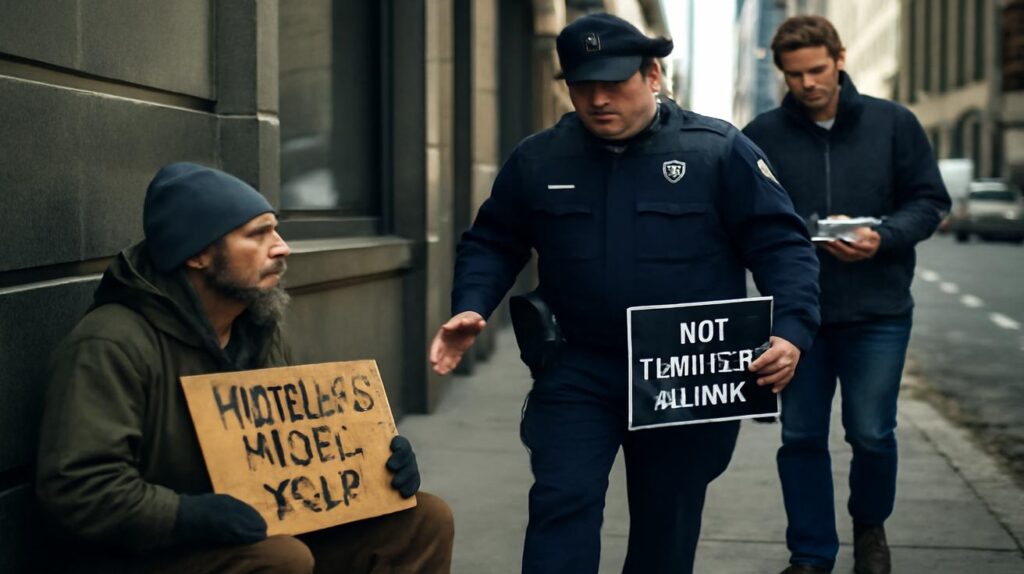
The first time I watched a city make saving a life into something like a misdemeanor, the smell of warm tortillas and car exhaust hung in the air. It was a soft spring evening, one of those dusky blue hours when downtown buildings glow like fish tanks, and a line of people were waiting quietly on the edge of a city park. A church group had pulled up in two aging minivans, sliding doors open, folding tables popped out like metal wings. Steam lifted from trays of beans and rice. Somewhere, a radio played old soul music through a crackling speaker. The only sharp sound was laughter—tired, but real—floating above the murmur of small talk between volunteers and the people they’d come to feed.
Then the patrol car rolled in.
The officer stepped out with the apologetic stiffness of someone who’d done this more than once. “You can’t serve food here,” he said, as if reading lines from a play he hated. “It’s against city ordinance. You’ll need to pack this up.”
A woman holding a ladle froze mid-scoop. A man waiting in line glanced at his friend with an expression that wasn’t quite anger and wasn’t quite surprise. It was quieter than outrage, deeper than disappointment. It looked a lot like recognition—of how far the city was willing to go to pretend these people didn’t exist.
This is where the story usually stops, right? Government crushes kindness. Charity becomes a crime. Humanity loses.
But what if that’s not the whole story?
When Good Intentions Make Bad Cities
If you’ve ever handed a burger out a car window to someone on a median, you know the small warmth that follows: I did something. A good deed in a brutal world. It feels human, and that feeling is real. But feelings and outcomes are not the same thing.
Across the United States and beyond, cities are quietly rewriting the rules of public compassion. They’re restricting food sharing in parks, fining people who hand out cash from car windows, and in some cases, charging volunteers who distribute tents or blankets on sidewalks. Civil rights groups call it criminalizing charity. City planners call it something else: taking back the public realm.
Neither side is completely wrong.
Urban planners, outreach workers, and even some formerly homeless people will tell you a hard truth: handouts can keep people alive tonight while keeping them stuck in misery for years. Camp cleanups are scheduled, shelters are half empty, outreach teams are walking the streets trying to coax people toward housing programs—and a block away, a well-meaning crowd arrives with food, clothes, and occasionally, just enough cash to buy the next high.
The result is a strange and haunting ecosystem: sidewalks that function as open-air waiting rooms for meals that arrive on random schedules; tent clusters held together not by community but by the gravity of donated stuff; trash bags of clothing piled behind convenience stores because no one can carry it all. It’s generosity as drift, scattered on the wind. The human heart wants to help; the city quietly drowns in unmanaged mercy.
So lawmakers start to ask a loaded question: When charity leaves people outdoors, sick, addicted, and still sleeping on concrete, is it truly kindness—or a ritual that lets the rest of us feel better while nothing fundamentally changes?
When Helping Hurts—and When It Heals
There’s a reason outreach workers often cringe when they hear the phrase “We just want to feed the homeless.” Feeding is essential—but feeding without relationship, without path, without any bridge to something different, can trap everyone in a loop that feels compassionate while cementing the status quo.
Picture two nights on the same city block.
On Monday, a group in matching t-shirts pulls up in a van. They’ve brought hot pizza, bottled water, and winter coats. They know the block by reputation but not by name. They serve quickly, move on, and post photos later with captions about “loving the least of these.” The people they served disappear back into the shadows. Tomorrow, most of them will wake up on the same piece of concrete.
On Wednesday, a different team arrives. Fewer people, no logoed shirts, no cameras. They bring food—but that’s not all. They bring clipboards, Narcan, phone chargers, and an invitation. They know names, histories, and which shelters won’t work for someone’s PTSD or wheelchair. They offer rides to detox or transitional housing, not just sandwiches. They’ll be back tomorrow, and the next day, and the next, because that’s the job: not to salve guilt, but to walk with people for the long, uneven distance between “outside” and “inside.”
Same sidewalk. Same hunger. Completely different form of charity.
This is where some cities have landed: it’s not that helping people is a problem; it’s that uncoordinated, drop-in-and-vanish charity can actively undermine the fragile networks that actually move people off the streets. Street outreach groups talk about “harm reduction” not just in terms of drug use, but also in terms of kindness. Does this act move someone one inch closer to safety, stability, and dignity—or does it keep them alive only to abandon them back to the cold?
Criminalizing Kindness—or Finally Getting Serious?
When cities write laws banning food sharing in public parks or ticket drivers for giving cash to panhandlers at intersections, the outcry is immediate and fierce: How dare you tell me not to be generous? What kind of society punishes kindness?
It’s the right question, but the answer isn’t as tidy as we’d like.
Some ordinances are, frankly, cruel. They’re not paired with any real investment in housing or services. They exist to push visible poverty out of sight of tourists and convention centers. On paper, they’re about “public safety” or “sanitation.” In practice, they are about optics. These are the laws that deserve resistance, the ones that would rather scatter people than support them.
But there is another kind of restriction emerging—born not from disgust, but from a frustrated kind of compassion. In growing numbers, cities are linking new limits on public handouts with expanded funding for coordinated outreach, sanctioned encampments with services, transitional housing, or low-barrier shelters. The message, at least in theory, is: You cannot do this here, this way—but you are welcome to help through structures that actually work.
In those places, the core idea is unsettling and radical at the same time: what if the city had a moral obligation not just to tolerate ad-hoc charity, but to organize it? To say, plainly, “No more random triage on sidewalks. If we are serious about ending street homelessness, we cannot keep doing emergency room medicine in a parking lot forever.”
This is where “charity becomes a crime” gets tangled with a much bigger question: Are we willing to trade the warm rush of personal giving for the colder, slower, less photogenic work of systems change?
How Bans Could Actually End Street Misery
It sounds backwards, even heartless, to suggest that outlawing handouts might reduce suffering. But under narrowly specific conditions—conditions that almost no politician is honest enough to spell out—that’s exactly what can happen.
For a ban on handouts to reduce misery instead of compounding it, three things have to be true at the same time:
- The city must expand, not shrink, real options: shelters people will actually use, detox beds, mental health care, transitional and permanent housing.
- There must be robust, well-funded outreach that meets people where they are, daily, with food plus pathways.
- Charity must be channeled, not crushed—redirected into those pathways instead of scattered across sidewalks.
Done this way, the effect can be startling. Sidewalks become less like emergency zones and more like waypoints. People who once bounced from church group to church group for meals begin to see familiar faces from outreach teams instead—people who don’t just remember their name, but also their paperwork, their last conversation with a caseworker, the housing list they’re inching up.
It’s not tidy or fast. Some will refuse help. Some will cycle through detox more than once; some will die before their name moves near the top of any list. But the crucial shift is this: the city stops outsourcing its conscience to whoever shows up with a folding table and starts treating homelessness as a shared, managed, solvable challenge.
In that world, saying “You can’t feed people on this corner” isn’t the end of the sentence. It continues: “…but here’s where you can support the work that feeds them tonight and houses them next month.” If that second half doesn’t exist, the ban is just cruelty in a cleaner uniform.
What We Think We’re Doing vs. What Actually Happens
It helps to lay out, side by side, the emotional promise of unregulated handouts and their real-world impact when no broader system is in place. The contrast is uncomfortable—and clarifying.
| What We Believe Handouts Do | What Often Actually Happens |
|---|---|
| Provide vital food and supplies to people who’d otherwise have nothing. | People get short bursts of resources, but still sleep outside, often steps away from shelter or services they’re not connected to. |
| Show unconditional love and solidarity with the poor. | Create brief contact with strangers who may never return, leaving no sustained support or path forward. |
| Reduce crime and desperation by easing immediate needs. | Can concentrate activity in certain areas, sometimes increasing conflict, exploitation, and overdose risks. |
| Relieve pressure on public systems, which “fail” the poor. | Let cities delay building housing and services by relying on volunteers to manage visible suffering. |
| Empower individuals to help directly, without bureaucracy. | Fragment efforts so much that no one has enough information or capacity to support long-term change. |
The point isn’t that handouts are bad. It’s that without integration into something larger, they’re like tossing life vests into a rip current. Some people will grab one. A few might make it to shore. But the ocean keeps pulling, and we keep telling ourselves that maybe we just need more life vests.
The Mirror We Don’t Want to Look Into
Here’s the part that exposes us: when cities move to limit casual charity, they don’t just test our policies—they test our motives.
If I’m honest, the most convenient version of compassion is the one that costs me little and asks nothing more of me than a moment and a few dollars. It does not require me to read zoning reports or attend public meetings about shelter siting. It does not push me to support housing projects on land I’d secretly prefer stay a park or a parking lot. It does not invite people I’ve fed to become my neighbors.
Street handouts are one of the last forms of socially sanctioned contact between housed and unhoused people. When a law steps in and says “not here, not like this,” it forces an ugly clarity: If we can’t feel generous in the old way, are we willing to be just, in a new one?
Because justice feels very different from charity. Justice is voting for taxes you’ll actually pay so a stranger you’ll never meet can have four walls and a door. Justice is supporting treatment centers, supportive housing complexes, and mental health clinics built not “somewhere else,” but possibly down your block. Justice is being willing to let your property values rise a little slower so that someone else’s life can rise at all.
Charity says, “I will give you something of mine.” Justice says, “I will change something of ours.” When charity is nudged—or shoved—off the sidewalk, the city is, intentionally or not, asking us which of those we actually believe in.
Empowered Cities, Accountable Hearts
Imagine, for a moment, a city that does this right.
Feeding people on sidewalks without a permit is technically illegal. But alongside that law, the city has built a flexible system of community kitchens, mobile outreach hubs, and low-barrier shelters. The church that once served food in the park now “adopts” a shelter one night a week, cooking dinner on-site and sitting to eat with residents. The student group that used to hand out socks downtown volunteers with a street medicine team once a month instead, walking the same blocks, but with a doctor and a social worker by their side.
The volunteer impulse isn’t crushed; it’s braided into a larger effort. The city, for its part, no longer hides behind volunteers; it funds what they plug into. Sidewalks slowly empty—not because people vanish into jails or distant suburbs, but because they move into rooms with doors that lock, showers with hot water, and neighbors who complain not about their presence, but about the noise from their kids’ bicycles in the hallway.
Will there still be tents? Yes. Will there still be people who refuse help, who prefer the chaos they know to the rules they fear? Absolutely. But the difference is no longer theoretical. In this city, a handout on the corner is not the only thing between a person and starvation. It is one blurred extra in a film already shooting, not the whole story.
And that’s why talking about banning handouts is so explosive: in most places, that film isn’t rolling. We criminalize charity without building capacity. We order the folding tables off the lawn and offer, in return, nothing but cleaner sightlines.
So the question isn’t simply: Should we ban handouts? It’s: Have we earned the right, morally, to even consider it?
What We Owe Each Other When the Van Drives Away
On that spring evening in the park, after the officer spoke, something unexpected happened. Instead of arguing, the group leader asked, “Where can we do this legally?” The officer hesitated. He mentioned a church lot across town, a designated meal site near a shelter, a city program that was “still being set up.” His voice lost its stiffness. “I’m just doing my job,” he added, but this time it sounded less like a shield and more like an apology.
People in line, still hungry, listened to two versions of the same city colliding: one where feeding them here, in this visible place, was a quiet act of resistance to indifference; another where feeding them there, in that structured place, might connect them to something beyond tonight’s paper plate.
A woman in a red hoodie stepped out of the line. “I don’t care where the food is,” she said. “I just don’t want you to forget about us when they move you.” She wasn’t talking to the officer. She was talking to the volunteers.
That’s the line that lingers.
Banning handouts will not end homelessness. It will not cure addiction or erase trauma. It will not repair the shredded safety nets that let people fall so far, for so long, without catching them. But it can, in some cases, expose the quiet choreography that already keeps things broken: cities leaning on volunteers, volunteers leaning on that feeling of anonymous goodness, everyone leaning away from the hard, boring, expensive work of building housing, treatment, and care.
So maybe the hardest, and most honest, way to think about these laws is not as a referendum on the poor, but as a referendum on us.
If charity becomes a crime, will we rage for a weekend on social media and then move on, relieved that no one is asking us to attend the budget hearing? Or will we follow our outrage all the way into the unglamorous trenches of policy and planning, where no one gets a selfie and the only “thank you” is a line item in the city ledger that says, in dry numbers, more people housed this year than last?
The real cruelty to the poor is not that we sometimes tell well-meaning people where and how they can give. It’s that so often, we don’t bother building anything worth directing that generosity toward. We accept a city where the sidewalk is the last safety net, and then call it compassion when we toss coins through the holes.
Maybe the real test is simple, and terrible in its simplicity: if every church group and student club and kind stranger on the corner vanished tomorrow, would anyone on the street still be fed, sheltered, and seen?
If the answer is no, then charity is not the crime.
Frequently Asked Questions
Are cities really making it illegal to help homeless people?
In some places, yes—but the details matter. Many cities have passed ordinances regulating where, when, and how food or supplies can be distributed in public spaces. Some require permits for large food sharings; others ban direct handouts at intersections. Punishments can range from warnings to fines. Whether this is “criminalizing charity” or coordinating it depends heavily on whether the city also provides robust services and alternatives.
Do handouts actually keep people on the streets longer?
Handouts can both save lives and unintentionally prolong street homelessness. When informal giving isn’t connected to outreach, housing programs, or treatment, it often meets immediate needs without creating any pathway off the street. Many outreach workers report that areas with abundant unsystematic handouts can make it harder to engage people in longer-term services because survival is possible without connection.
Isn’t any act of kindness better than doing nothing?
Kindness is essential, but not all forms of help have equal impact. Some acts, like giving cash to someone in active addiction without connection to support, can unintentionally fuel harm. The most powerful help tends to combine immediate relief with relationship and a clear next step—like supporting coordinated outreach teams, shelters, and housing programs rather than only one-off encounters.
How can I help if my city restricts giving on the street?
You can volunteer with or donate to organizations that work directly with unhoused people, such as shelters, street outreach teams, harm reduction programs, and legal aid groups. You can also advocate for more affordable housing, treatment access, and mental health services, and show up to local meetings where these issues and budgets are decided.
Does banning handouts violate religious freedom or moral obligations?
Some faith groups argue that feeding the poor is a core religious duty that should not be restricted. Courts have sometimes agreed and sometimes upheld city regulations as long as they are applied fairly and leave meaningful ways to fulfill that duty. Even when laws stand, the moral question remains: societies must balance public order with the deep ethical imperative to care for vulnerable people. That balance is far more defensible when cities provide strong, accessible alternatives to sidewalk charity.