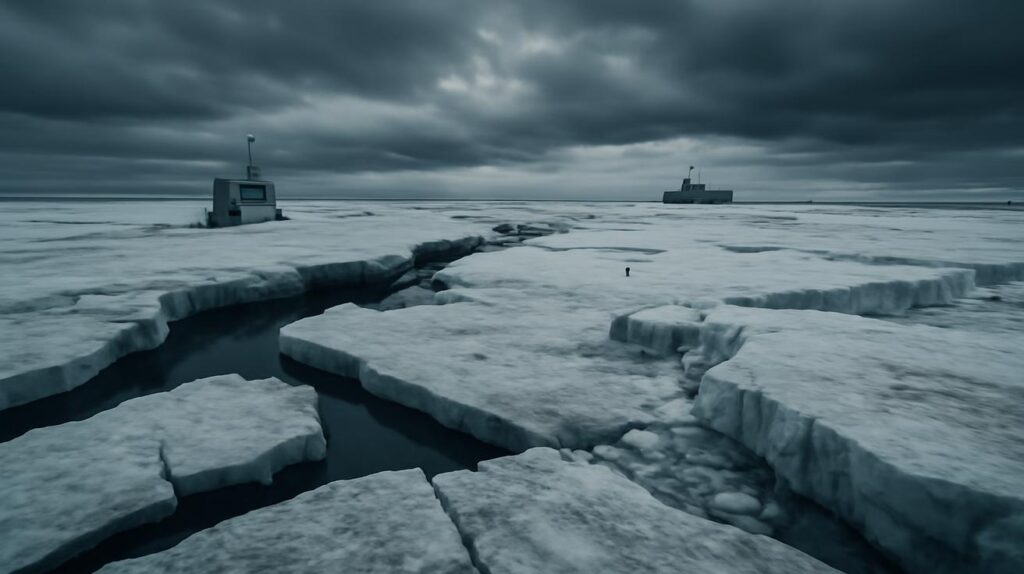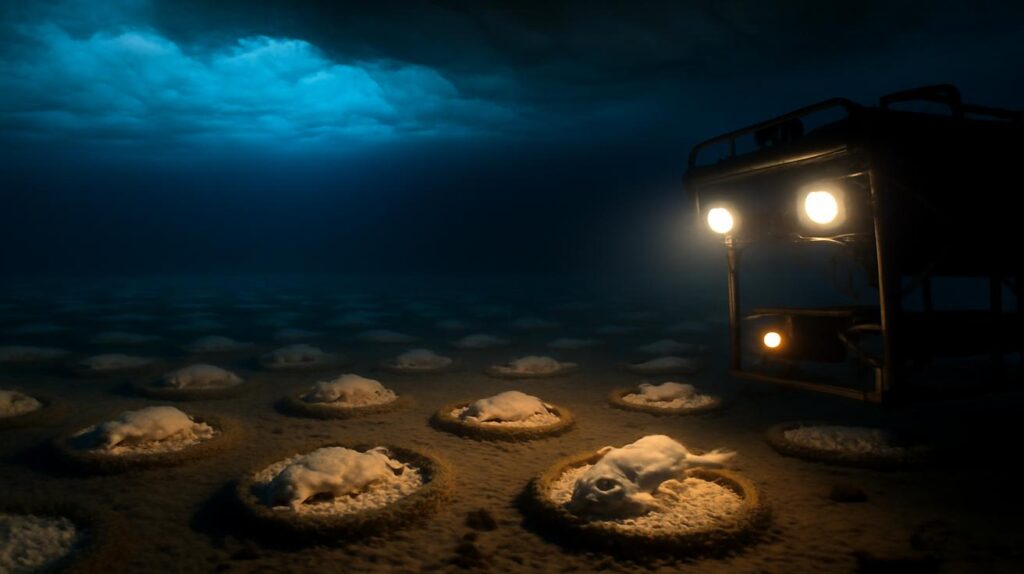
The first thing you notice is the sound—or rather, the absence of it. The sea ice stretches out like a frozen sheet of glass, and the world feels muffled, as if someone has put a hand over the planet’s mouth. A research vessel nudges through loose floes off Antarctica’s Weddell Sea, metal groaning softly in the cold. Inside, scientists huddle over screens, expecting to see nothing more than a flat, desolate seafloor drifting past the cameras. Just the usual: mud, scattered rocks, maybe a lonely starfish crawling by. Instead, the screen fills with circles. Perfect, tidy circles. One after another after another. And in each circle—eggs. Thousands of them.
The Day the Seafloor Turned into a City
It began as routine data collection, the kind of quiet work that defines so much of polar research. The team aboard the German research icebreaker RV Polarstern had lowered a camera system—a kind of underwater sled bristling with lenses and sensors—beneath nearly a meter of ice. Their goal was to map the seafloor, measure ocean properties, gather footage, and then move on.
The water was black and frigid, hovering around –1.8°C, that strange supercooled state that seawater can reach before it freezes. The sled drifted a meter or two above the bottom, towing a beam of light through the darkness. Then came the circles on the monitor. A round, shallow bowl in the sand. A fish hovering protectively nearby. Another bowl. Another fish. Then dozens. Then hundreds.
At first, it looked like an odd patch of nesting activity—special, but not world-changing. Fish make nests, after all. But the camera kept moving. The circles did not stop. Half an hour later, the science team was silent, eyes locked on the trail of images, realizing what was unfolding in front of them: they weren’t just looking at a few nests. They were looking at a vast colony. A city beneath the ice.
The Hidden Architects of the Ice: Jonah’s Icefish
The residents of this frozen metropolis are not the big, flashy creatures that normally grab headlines about Antarctica. They’re not penguins or orcas or seals. They’re small, pale fish called Jonah’s icefish—Neopagetopsis ionah—a species that seems almost engineered for a science fiction story about the deep cold.
Icefish have clear blood. That’s not a poetic flourish: their blood is nearly colorless because they lack hemoglobin, the iron-rich molecule that makes our blood red and carries oxygen around the body. In the oxygen-rich, icy waters of Antarctica, they’ve carved out a niche that lets them live with this peculiar quirk. Their bodies are translucent, ghostlike in the camera light, fins fluttering delicately as they fan water over their eggs.
Each nest is a simple structure: a shallow bowl, about 15 centimeters deep and 75 centimeters wide, sculpted into the soft seafloor. In the middle lies a cluster of eggs—soft, milky-white spheres—and at the edge, a guarding adult. Some nests hold more than 1,500 eggs. Some are carefully cleared of debris. Others are abandoned or filled in with silt, the empty houses of a neighborhood that has already hatched and moved on.
Icefish parenting may not sound glamorous, but in these waters, it is an act of stubborn, quiet dedication. The adult stays put, fanning the eggs with its fins to keep oxygen flowing, protecting them from predators and smothering sediments. This is no casual reproduction strategy. It’s a long, energy-costly investment—and it only makes sense if the surrounding conditions are reliably good. That’s exactly what the scientists were about to discover.
A Seafloor That Wouldn’t End
The camera sled covered kilometer after kilometer. Back on board, someone started counting nests on the video. Then they ran a quick estimate based on the density of nests and the area of the colony. About 60 million nests, they concluded. Not 60. Not 600,000. Sixty. Million.
The nesting colony covered an area of roughly 240 square kilometers—about the size of a major city. Imagine a metropolitan map, then erase the buildings and streets and replace them with circular fish nests, each with their own guard, their own clutch of eggs, their own quiet drama playing out in icy darkness. It is, as far as scientists know, the largest fish breeding colony ever discovered on Earth.
In a world where we often talk about how much we still don’t know about the deep ocean, this find felt like a revelation. Here was a thriving, meticulously organized, utterly enormous ecosystem hidden directly beneath a sheet of Antarctic ice, in a place previously thought to be monotonous and largely barren. The Weddell Sea, already known for its massive ice shelves and swirling currents, had just unveiled one of its most intimate secrets.
Why Here? The Subtle Clues of an Invisible Current
A natural question followed: why here, and why so many? The answer, as usual in the ocean, comes down to water. Not just any water, but a specific, slightly warmer, nutrient-rich water mass that creeps up from the deep.
Oceanographic instruments around the nesting site began to paint a picture. There was a tongue of water about 2 degrees Celsius—a whisper warmer than the freezing waters around it—rising from greater depths and flowing steadily through this patch of seafloor. That tiny temperature difference matters. Warmer water speeds up egg development just enough to give the icefish a reproductive edge, and it carries more oxygen, feeding the embryos’ growing demand.
To the fish, this location is not arbitrary. It is precisely tuned to the flow of that water, the shape of the seabed, and the seasonality of the sea ice above. The ice acts like a protective roof, sheltering the nests from storms and waves. The ocean brings just the right kind of water over the nests, like a gentle, perpetual breath. It is as if the entire environment has conspired over millennia to create the perfect nursery.
Scientists suspect this colony has probably existed, in one form or another, for thousands of years. Icefish generations have returned here, and the colony has persisted quietly through ice ages and warming pulses, waxing and waning as the climate and currents subtly shifted. No human knew. No satellite saw. Only when a camera sled happened to pass overhead, in the right place at the right time, did the secret break the surface.
The Nursery That Feeds an Ecosystem
It’s easy to imagine this colony as a closed world: fish, eggs, and icy water, looping endlessly. But in reality, it is a linchpin in a wider food web. Icefish are prey for seals, penguins, and larger fish. Their eggs and larvae, drifting in the currents once they leave the nest, feed a host of smaller predators.
The discovery of tens of millions of nests means tens of billions of eggs. That’s a staggering amount of energy being pumped into the ecosystem. A banquet, not just for one predator, but for many.
In the Antarctic, where productivity is tied closely to ice, light, and seasonal plankton blooms, this kind of massive, predictable breeding event becomes the biological heartbeat of a region. It’s the sort of thing that animals learn to time their lives around—migrations, feeding trips, breeding cycles layered upon breeding cycles, all anchored to those ghostly fish beneath the ice.
Seeing the Invisible: Technology Meets Ice and Darkness
The fact that this colony remained hidden for so long isn’t because it’s small or subtle. It’s enormous. But the Antarctic is a master of concealment. Sea ice keeps ships at bay. Harsh weather makes fieldwork brutally difficult. And the deep ocean, even when humans reach it, reveals only what falls within the narrow cone of an artificial light.
The camera system used in this discovery is known as an OFOBS—Ocean Floor Observation and Bathymetry System. Picture a metal frame, dragged slowly above the seabed, cameras pointed downward, lights cutting through the darkness. It sends back high-resolution images and sonar data in real time, letting scientists stare into the abyss from the relative warmth of the ship.
The innovation is not in some single, spectacular piece of tech, but in patience. Slowly towing a camera across hundreds of kilometers of seabed, trip after trip, compiling images, watching, waiting. It’s the kind of work that doesn’t look like much when you compress it into a highlight reel—but every now and then, the ocean rewards the persistence.
To capture and understand this discovery, the scientists didn’t just rely on cameras. They cross-checked temperatures, salinity, and currents, and layered those findings onto maps of the seafloor. Piece by piece, they reconstructed the invisible architecture that turned a patch of mud into a planetary-scale nursery.
A Snapshot of a Changing Planet
No Antarctic story is complete without climate change shadowing its edges. The Weddell Sea is one of the more stable and icy regions of Antarctica—for now. But even here, the ocean is warming, currents are shifting, and ice shelves are thinning.
This newly discovered colony is exquisitely sensitive to its environment: change the flow of deep water, tweak the temperature by a few tenths of a degree, alter the timing or extent of ice cover, and the conditions that make this place so perfect for icefish reproduction could unravel.
The discovery doesn’t come packaged with doom. It comes as a baseline—a precious “before” picture in a rapidly changing world. Scientists now know where this enormous colony is, how dense it is, and what physical conditions support it. That means future researchers can return, measure again, and ask the most important question of our time: what is changing, and how quickly?
Antarctica’s Unexpected Intimacy
For all its scale and harshness, Antarctica has a strange way of feeling intimate when you get close enough. Inside each of those nests is a cluster of lives that have never known sunlight, only the dim shimmer of filtered blue under ice. A devoted parent circles its bowl, fins brushing the edges, as if tidying a crib. In the stillness of the deep, a single air bubble rises toward the ice ceiling, like a thought breaking the surface.
There is something touching, almost domestic, about a fish nest carefully kept, guarded in the cold. In a place we imagine as brutal and empty, there are neighborhoods of care. Each nest is a decision: this is where I will pour my energy, this is where the next generation will begin. Multiply that by millions, and the seafloor becomes a patchwork of intentions—of quiet determination written in sand and eggs.
Knowing this exists changes the way the map of Antarctica feels. That blank patch of the Weddell Sea is no longer just a blue smear on a globe. It is a living place, with homes and boundaries and risks. The ice overhead becomes not just a sheet of frozen water, but the roof of one of Earth’s largest nurseries.
For the scientists who watched the video feed that day, the moment of realization was something close to awe. It was as if the ocean had cracked open a door for a second, inviting them to glimpse a secret world that had been busy all along, unbothered by human ignorance.
A Colony in the Numbers
Story and emotion aside, the raw numbers of this discovery help make sense of just how extraordinary it is.
| Feature | Details |
|---|---|
| Location | Weddell Sea, Antarctica, beneath sea ice |
| Estimated area of colony | ~240 km² (roughly the size of a large city) |
| Estimated number of nests | ~60 million |
| Typical nest size | ~75 cm in diameter, 15 cm deep |
| Eggs per nest (approx.) | Up to 1,500 or more |
| Water temperature over nests | Around 0–2°C, slightly warmer deep water flowing upward |
| Species | Jonah’s icefish (Neopagetopsis ionah) |
Looking at those numbers, the scale becomes almost abstract. Sixty million of anything is difficult to picture. Yet, beneath that ice, it’s not abstract at all. It’s real: one nest after another, each one a small bowl dug by a real fish, each egg with its own precarious chance at life.
What This Discovery Means for the Future
The accidental discovery of this vast nursery has already shifted how scientists think about the Southern Ocean. It highlights how much of Earth’s biodiversity is still off the map—literally. If a colony this large could go unnoticed in waters that have been visited by research ships for decades, what else lies hidden in other remote corners?
It also adds urgency to the conversation about protecting the Weddell Sea. Many researchers and conservation groups have long argued that this region deserves the status of a Marine Protected Area (MPA), citing its unique ecosystems and importance for global ocean circulation. The icefish colony is a potent new argument: you don’t risk bulldozing the nursery of millions of animals without thinking carefully about the consequences.
Policymakers and scientists now face a delicate balancing act—ensuring that fishing, tourism, and research are managed in a way that doesn’t destabilize this hidden city of nests. It’s not just about preserving a curiosity; it’s about safeguarding a key engine of life in the Antarctic food web.
There is, too, a quieter contribution. Stories like this shift our imagination. The next time you look at a map of Antarctica or see footage of a ship pushing through pack ice, it’s hard not to wonder what’s going on beneath that pale, opaque crust. Our planet is far from fully known. It is still capable of surprises that feel almost mythic in scale.
The Ocean Still Has Secrets
The discovery of millions of fish nests under Antarctic ice reads like a reminder from the planet: you haven’t seen everything yet. For all our satellites, supercomputers, and drones, the ocean continues to hold its cards close.
Somewhere, right now, an icefish is circling its nest, fanning its eggs with methodical grace. It has no idea that humans have finally noticed. Its world is framed by cold water, soft sediment, and the faint glow of polar seasons filtering down through ice. The fact that we now know its story is not the end of the mystery. It’s the beginning.
Centuries from now, if future scientists want to understand how Earth’s oceans once were, this colony—if it survives, if it’s monitored, if it’s protected—could be one of their reference points. “Look,” they might say, “this is what the Antarctic nursery used to look like. This is what the sea was capable of when we first started paying attention.”
For now, the discovery stands as one of those rare moments when the scientific world and the storytelling world share the same emotion: a kind of stunned, grateful awe. Thousands upon thousands of fish nests, a secret city on the seafloor, quietly thriving in the dark, waiting all this time for a camera to drift past and bear witness.
Frequently Asked Questions
How were the fish nests discovered beneath the Antarctic ice?
They were found accidentally during a research expedition in the Weddell Sea, using a towed camera system (an OFOBS frame). Scientists were mapping the seafloor and expected to see mostly bare sediment, but instead the video feed revealed millions of circular nests, each guarded by an adult fish and filled with eggs.
What species of fish builds these nests?
The nests belong to Jonah’s icefish (Neopagetopsis ionah), an Antarctic species known for its nearly transparent body and blood lacking hemoglobin. These fish are specially adapted to the cold, oxygen-rich waters around Antarctica.
Why is this discovery considered so important?
It is the largest known fish breeding colony on Earth, with an estimated 60 million nests over about 240 square kilometers. The colony likely plays a major role in the Antarctic food web and provides a crucial baseline for understanding how climate change and human activities might affect the Southern Ocean.
Why do the nests form in that specific area?
The nesting site coincides with a flow of slightly warmer, oxygen-rich deep water that rises over the seafloor in this region. That subtle warmth and consistent current appear to create ideal conditions for egg development, turning this patch of ocean floor into a natural nursery.
Are these fish and their nests protected?
At present, large parts of the Weddell Sea remain relatively untouched, but there is growing pressure to establish formal Marine Protected Areas to safeguard ecosystems like this nesting colony. The discovery has strengthened the case for protection, and ongoing discussions aim to ensure that any fishing or other human activity does not harm this unique habitat.
Could climate change threaten the colony?
Yes. Changes in ocean temperature, currents, and sea-ice cover could alter the conditions that make this site such a good nursery. Even small shifts in temperature or water flow may affect egg development and survival, making long-term monitoring and protection especially important.
Will scientists return to study the nests again?
Follow-up expeditions are planned and, in some cases, already underway. Researchers aim to track the colony over time, study the behavior and life cycle of the icefish in more detail, and monitor how environmental changes might be influencing this remarkable underwater city of nests.