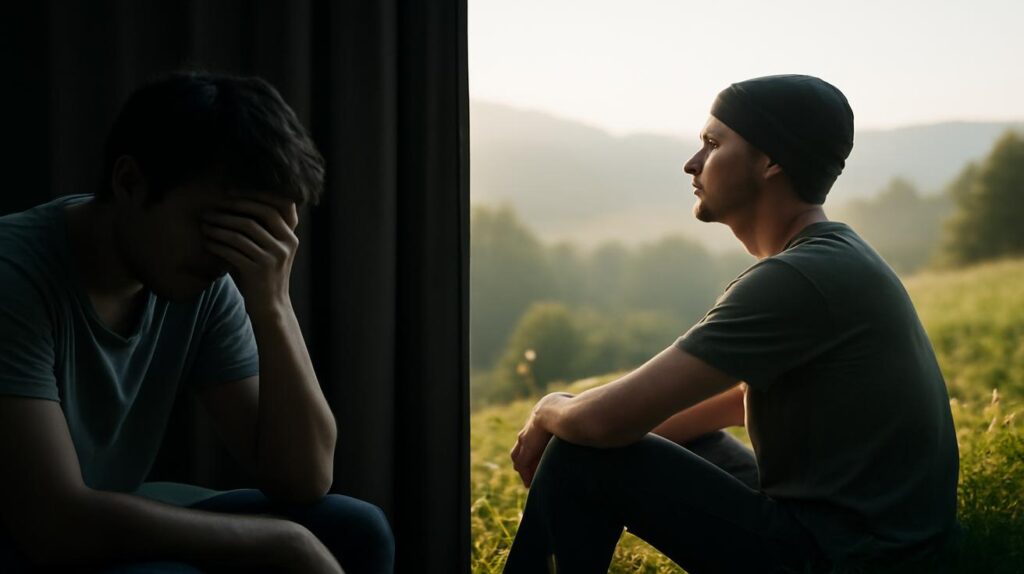
The first time I noticed the difference between running away and simply stepping back was on a fog-heavy morning in early autumn. I was walking a trail that curved along the edge of a lake, the kind of path that feels like it’s been carved gently by time, not machines. The mist sat low on the water, erasing the opposite shore so completely it felt like I was standing at the edge of the world. A pair of loons floated nearby, their bodies barely disturbing the glassy surface, black eyes watchful and calm. When I shifted my weight on the damp wooden planks of the dock, they didn’t startle. They just drifted a little farther out—measured, unhurried, as if to say: I see you, and I’m choosing my space.
It struck me then how different their movement was from the flurry of ducks I’d seen earlier in a city park, birds that exploded into the air every time a child ran too close. Those ducks weren’t creating space; they were fleeing. Same direction—away from something—but completely different energy. And I wondered: if someone could watch the movement of my mind, my friendships, my messages left on read, my quick changes of subject, would they see the still, deliberate glide of the loon…or the panicked flapping of the startled ducks?
The Wind in the Grass and the Noise in Our Heads
Spend enough time outside, and you start to notice how everything negotiates distance. Grasses lean away from wind gusts and then return upright, as if they’ve agreed on how far is far enough. A fox slipping along a hedgerow keeps just beyond your direct gaze, tuned to the invisible line between curiosity and threat. The forest, somehow, is a map of boundaries in motion—nothing is static, but nothing is random either.
Inside our own lives, that negotiation of distance gets far messier. We pull away from people we love. We ghost group chats we once checked every hour. We say “I’m fine” when we are anything but—and then we stop saying much at all. To the outside observer, it can look like a simple act of retreat: you move away, you answer less, you appear less. But on the inside, there is a psychological canyon between avoidance and intentional distance—a canyon we often don’t realize we’re walking into until we’re already on the wrong side.
In the quiet of a trail or the stillness of a frozen pond, it’s easier to feel the difference. Avoidance hums like an anxious insect in the back of your mind, always searching for the next thing to dodge. Intentional distance, by contrast, settles into the body like a deep breath in cold air: clear, awake, a little uncomfortable, but oddly steady. Both create space. Only one creates peace.
The Hidden Physics of Avoidance
Avoidance, psychologically, is less about where we are and more about what we’re trying desperately not to touch. Imagine a tight, overgrown thicket along the trail, filled with brambles and low, grasping branches. There’s something in there—a fallen bird’s nest, a lost glove, a weathered sign from decades ago—but it’s easier not to find out. You feel the catch on your jacket, the sting on your skin, and your body whispers: not that way. So you circle wider and wider, convincing yourself the thicket was never on your planned route anyway.
In life, that thicket might be a conversation you won’t have with your partner because it might threaten the fragile truce you’ve built. It might be a phone call to a parent whose approval you crave and fear in equal measure. It might be a memory you’ve shoved into a mental drawer and taped shut, promising yourself you’ll never pull it open. Avoidance isn’t simply choosing distance; it’s choosing not to know, not to feel, not to risk touching something painful—even if, in avoiding it, you scrape yourself against a dozen other unseen branches.
Psychologists often talk about avoidance as a short-term solution that charges interest. You get immediate relief: your pulse slows, your chest loosens, the threat seems to shrink once it’s out of sight. But over time, what you’re avoiding grows teeth. Your world tightens. The party you skip turns into all social gatherings. The conversation you dodge expands into a silent, thick distance. The anxiety that once whispered now shouts whenever you get too close to the thing you’re trying not to see.
Like a deer that learns to bolt at every snapped twig, avoidance trains your nervous system to overreact. The body and mind form a pact: “Escape first, ask questions never.” You begin to fear not only the difficult thing itself, but your own capacity to handle it. Distance becomes synonymous with safety, but it’s the safety of a cage—a widening no-go zone that eventually touches parts of your life that were never dangerous to begin with.
How Avoidance Feels From the Inside
On a sensory level, avoidance often feels like a tightening, a narrowing. Your shoulders creep upward, your breath shortens, your stomach turns. There’s a swiftness to it, a compulsion. You glance at a name on your phone and feel your thumb swipe away almost before you notice the urge. Your mind throws up excuses like sparks: “Now’s not a good time,” “I’ll be more present if I wait,” “They probably don’t really want to hear from me anyway.”
There’s usually a story humming beneath it all: If I stay, I’ll be overwhelmed. If I try, I’ll fail. If they see the real me, they’ll leave. Instead of stepping toward those beliefs to test them, avoidance keeps you orbiting them, making them look larger and more solid than they are.
In nature, you see avoidance when prey animals sprint blindly, crashing through underbrush, sometimes injuring themselves in the chaos of escape. In your own life, you might notice the echoes: slipping into hours of scrolling to dodge discomfort, working late every night to avoid the silence at home, bending yourself into a pleasing shape so you don’t have to risk someone’s disapproval. You move fast, but rarely feel like you’re going anywhere.
The Clear Edges of Intentional Distance
Intentional distance, by contrast, is more like stepping back to see the whole mountain instead of pressing your nose against one rock. It has the feeling of turning your face toward a cool breeze after a long, stuffy car ride. The movement might look similar—time apart, fewer messages, a pause in an ongoing conflict—but the motivation is different, and your nervous system knows it.
Imagine sitting on a boulder near a river that has swelled with spring melt. The water is loud, churning, insistent. You can stand at the very edge, toes nearly over the line, feeling the spray on your face. Or you can take three steps back, where the sound softens just enough that you can hear your own heartbeat again. The river doesn’t change. You do.
Intentional distance is a choice made with eyes open. You’re not pretending the river isn’t there; you’re respecting both its power and your own limits. You might say to a friend, “I care about you deeply, and I need a few weeks to sort through what I’m feeling before we talk about this again.” Or to yourself: “I’m going to close my laptop at 6 p.m. and leave work at work so I can hear what else my life is saying to me.”
This kind of distance doesn’t swell in secret. It’s usually communicated, even if only to yourself. There’s a sense of ownership to it: I’m choosing this space, and I remain responsible for what happens inside it. You don’t slip out a side door; you walk out the front one, gently, with your hand still on the knob.
The Emotional Texture of Healthy Space
In your body, intentional distance often feels like a fuller breath. There might be sadness, fear, or uncertainty, but underneath there’s a thread of steadiness. You’re not scrambling for escape; you’re making room for perspective. It’s the difference between leaving town because the house is on fire and going on a solo camping trip to think clearly.
In nature, intentional distance shows up in the way birds choose nesting sites: not too close to predators, not too exposed to storms, not so isolated that food is scarce. It’s strategic space. In your life, it might look like setting boundaries with a family member who loves you but constantly crosses lines. Or taking a social media break not because the world is unbearable, but because you want to hear your own voice again.
Crucially, intentional distance doesn’t deny discomfort; it honors it as information. It says: “Something here is too much for me as I am, at this moment. Let me step back, not to erase it, but to meet it better.”
Side by Side: Avoidance vs. Intentional Distance
From far away, avoidance and intentional distance can look like the same behavior: unanswered texts, canceled plans, time alone, silence. But if you step closer—if you listen to the rustle of the inner undergrowth—you’ll find clear differences. The table below lays out some of these contrasts in a way that can be easier to feel than to simply define.
| Aspect | Avoidance | Intentional Distance |
|---|---|---|
| Core motivation | Escape discomfort or perceived threat | Create clarity, rest, or perspective |
| Emotional tone | Anxious, rushed, guilty, confused | Calm (or calmly sad), deliberate, grounded |
| Awareness | Often semi-conscious, reactive | Conscious choice, reflected on |
| Communication | Unspoken, vague, sometimes deceptive | Usually communicated and defined |
| Long-term effect | Shrinking world, growing fear | Wider perspective, stronger boundaries |
If you imagine your life as a landscape, avoidance is like drawing more and more areas on the map with “Here Be Monsters” scribbled over them. Whole sections get shaded out: certain conversations, certain risks, certain types of intimacy. You might still roam, but only in ever-tightening circles.
Intentional distance, instead, is like marking spots as “Resting Place,” “Scenic Overlook,” “Dangerous in Storms Only.” You’re not deciding never to go there; you’re deciding how and when to go, and with what equipment. One shrinks your world to protect you from your fears. The other arranges the world to protect your capacity to stay present.
Questions to Feel the Difference
The same behavior—say, taking a few weeks off from seeing a close friend—can land on either side of this psychological line. Often, the most honest clue is not what you’re doing, but why and how. Asking yourself questions like these can help you feel which side you’re standing on:
- Am I stepping back toward something (rest, clarity, healing) or simply away from discomfort?
- Have I named this choice—to myself and, when appropriate, to others—or am I hoping it goes unnoticed?
- Do I feel more or less empowered when I imagine taking this space?
- Is this distance helping me eventually face what’s hard, or giving me reasons to never face it?
The answers are rarely neat. Human beings are rarely neat. But even a small tilt toward honesty shifts the ground under your feet.
Learning to Step Back Without Disappearing
There’s a quiet art to creating intentional distance in a culture that often celebrates either constant availability or total withdrawal. We’re trained to answer quickly, to show up everywhere, to treat our nervous systems like endlessly renewable resources. When they falter, avoidance can feel like the only lever we know how to pull: shut down, ghost, bail.
Nature offers a different template. Trees drop their leaves when winter approaches, not as an act of defeat, but as a strategy: conserving energy, protecting their core. Migratory birds vanish from a landscape long enough that we name the emptiness after them—where are the warblers, the swallows, the cranes? But their absence is not abandonment; it’s survival, timing, the wisdom of knowing where they cannot thrive in a given season.
In your own life, shifting from avoidance to intentional distance might begin with the simplest of words: “I need.” They are surprisingly hard to say. “I need a few days before I can talk about this.” “I need to say no to this project so I can do justice to the ones I already have.” “I need some space to figure out what I’m feeling—not because you don’t matter, but because you do.”
This is not the language of escape. It’s the language of stewardship: of your time, your attention, your nervous system. And it allows the people who love you to know what’s happening, instead of leaving them to guess in the dark silence of your disappearance.
Small Practices for Healthy Distance
Like building up trail stamina, cultivating intentional distance starts with small, repeatable steps:
- Name your limits early. Notice the first stirrings of overwhelm—tight jaw, tired eyes, irritability. Say, even quietly to yourself, “I’m nearing my edge.” This turns the edge into information, not failure.
- Timebox your retreat. Instead of “I can’t deal with this,” try “I’ll revisit this email tomorrow morning when I’ve rested.” Give your distance a boundary in time.
- Share your map. When possible, tell people, “I’m going to be less available this week because I need to recharge. It’s not about you.” It takes courage, but it builds trust.
- Return on purpose. When the time you set is up, experiment with stepping back in—even if only a little. Avoidance lets time drift; intentional distance honors the cycle of away-and-back.
None of this requires perfection. There will be days when your “intentional distance” is really avoidance in nicer clothing. There will be conversations you delay longer than you should, messages you don’t answer because it’s easier. The point is not to become some serene boundary-master, but to notice when you’re flapping like the startled ducks instead of gliding like the loons—and then to bring a bit more choice into the movement.
Re-entering the Clearing
Eventually, even in the thickest forest, the path opens into a clearing. The light falls unobstructed, soft on your face. You can look back at the path you walked and see, with a little distance, where you veered sharply to avoid a fallen log, or where you deliberately paused to listen to the wind in the trees. From above, on some imagined map, those movements might look similar: lines curving, stopping, circling. But inside your body, you know exactly which were which.
The psychological difference between avoidance and intentional distance is not some academic nuance; it’s the difference between a life shaped by fear and a life shaped by care. Care for your own limits, care for the truth, care for connection that can withstand both closeness and space. Avoidance puts your back to what scares you and hopes it never taps your shoulder. Intentional distance faces it, bows politely, and says, “I’ll meet you when I can bring my whole self.”
As you move through your own days—through buzzing phones and layered relationships, through grief that creeps in at the edges of errands, through joy that sometimes feels too bright to look at—notice where you pull away. Ask yourself, not with judgment but with the curiosity you might bring to an unfamiliar birdcall, “Am I running, or am I resting? Am I vanishing, or am I making room?”
There’s no perfect formula. But there is a feeling in the body, a quiet alignment, when you step back with intention rather than in panic. It feels, oddly, like the moment the fog lifts off the lake and you realize the opposite shore was there all along. Distance did not erase it; it only obscured it for a while. Now, with clearer air and steadier breath, you can decide if, when, and how to cross.
FAQ: Avoidance vs. Intentional Distance
How can I tell in the moment if I’m avoiding or taking intentional distance?
Pause and check three things: your body, your story, and your plan. If your body feels tight and urgent, your inner story is “I can’t handle this,” and you have no clear plan to revisit the situation, you’re likely in avoidance. If your body feels steadier (even if sad), your story is “I’m choosing space to handle this better,” and you have a rough idea when you’ll return to it, you’re probably taking intentional distance.
Is avoidance always unhealthy?
Short-term avoidance can sometimes protect you from immediate overwhelm—like not reading a painful message until you’re in a safe place. It becomes unhealthy when it becomes your default strategy, shrinking your life and preventing you from processing what you need to face in order to heal or grow.
Can intentional distance hurt relationships?
It can feel uncomfortable, but when communicated clearly, intentional distance often strengthens relationships. Saying, “I need some time to think, but I care about you and I will come back to this,” is usually less damaging than staying physically present while emotionally shutting down or exploding from unprocessed stress.
What if the other person thinks my intentional distance is rejection?
You can’t fully control others’ interpretations, but you can reduce confusion by being as honest and specific as you can: explain why you need space, affirm your care, and—if appropriate—offer a timeline for reconnecting. Over time, consistent behavior (leaving and returning as you said you would) teaches others that your distance is not the same as abandonment.
How do I start changing unhealthy avoidance patterns?
Begin with very small experiments. Pick one avoided task or conversation and set a tiny, time-limited goal: five minutes of effort, one honest sentence, one step closer. Support yourself with grounding practices—deep breaths, a walk outdoors, talking with a trusted friend or therapist. Each time you face rather than flee, you teach your nervous system that you can survive contact with what scares you, which gradually makes intentional distance easier and pure avoidance less necessary.