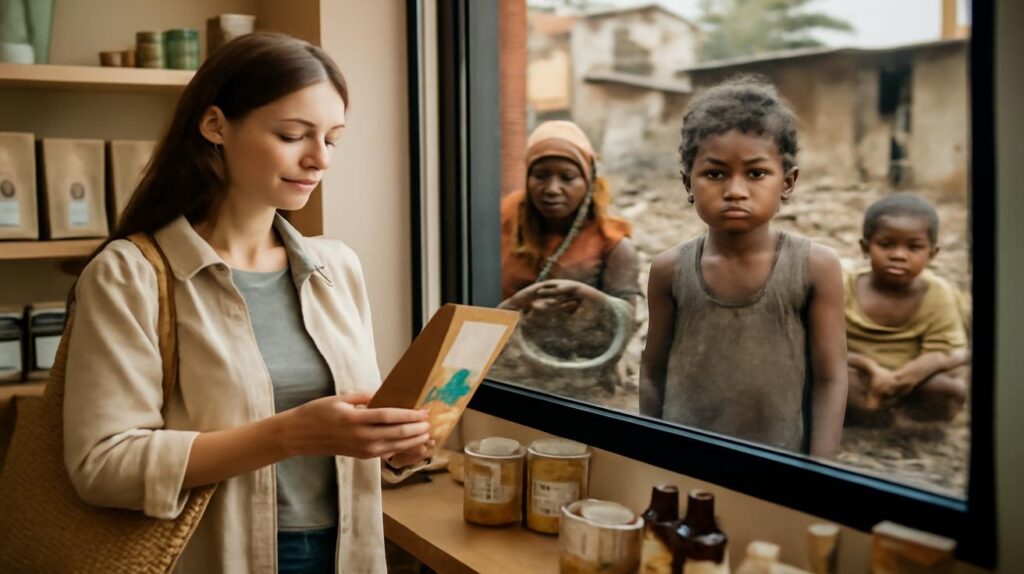
The woman behind the coffee counter smiles as she hands you a perfectly poured oat-milk latte, its foam rippling like a tiny golden cloud. A small green logo on the bag of beans promises “fair trade,” “sustainably sourced,” “ethically grown.” You take a sip and feel a little rush of satisfaction that has nothing to do with caffeine. This cup, you tell yourself, is different. This cup is doing good. Somewhere, a farmer is getting a fairer deal because you chose this coffee and not the cheaper one on the supermarket shelf.
The comforting story we buy with every purchase
We like to believe that in a world of melting ice caps and collapsing ecosystems, our shopping baskets can double as ballot boxes. Your reusable tote bag becomes a quiet act of rebellion. Your eco-friendly sneakers are a statement, your cruelty-free serum a love letter to animals you’ll never meet. “Ethical consumption” is not just about what we buy; it’s about who we are and who we want to be.
Brands have learned this quickly. They don’t just sell products anymore; they sell narratives. Your fair-trade coffee doesn’t just wake you up—it “empowers smallholder farmers.” Your bamboo T-shirt “heals the planet.” Your shampoo bar “saves the oceans.” Each label offers a piece of redemption: a promise that you can keep living more or less the same life, just with better choices and nicer packaging.
But if you start to scratch at those beautiful labels, something uncomfortable appears: a bitter irony. Many of the products that reassure us we’re doing the right thing are built on half-truths, clever marketing, and systems that still leave the most vulnerable people at the bottom of the ladder. The story feels clean. The reality is not.
The fine-print reality of fair-trade coffee
Imagine a hillside in Latin America just after dawn. Mist hangs low above the coffee plants. A farmer moves slowly along the rows, fingers stained by cherries, back aching from decades of bending. For this farmer, the term “fair trade” is not a warm feeling; it’s a line item in a contract—the difference between selling beans at a cut-throat world price or at a slightly better, more stable minimum.
On paper, fair-trade schemes offer hope: a guaranteed floor price, sometimes a small premium for community projects, and standards around labor and environmental practices. In practice, the picture is tangled. Certification is expensive and bureaucratic. Many small farmers can’t afford to join or lack access to the cooperatives that interface with fair-trade buyers. Those who do qualify still face a volatile market where “minimum price” doesn’t magically translate into a living income.
Then there’s the issue of who captures the value. By the time that coffee reaches your cup in a stylish café, its price may have increased five, ten, twenty times. Yet the additional money you’re paying for that halo of virtue rarely flows proportionally upstream. Roasters, traders, certifiers, and retailers often capture the largest margins. The farmer still fights to pay for seeds, fertilizer, children’s school fees—all while dealing with climate change that threatens their very ability to grow coffee.
Still, when you stand in front of a shelf and see a fair-trade logo, it feels decisive. “At least this is better,” you think. And often it is, in relative terms. But here’s where the irony stings: our belief that the label alone is enough can dull our curiosity about what “better” really means—and who’s still being left behind.
When ethics become just another marketing angle
Walk down any high-end grocery or lifestyle store and you’ll see aisle after aisle of products whispering the same story: ethical, sustainable, conscious, responsible. The language is soft and reassuring, a down blanket for a guilty conscience.
Brands know the emotional power of these words. Many sprinkle them over packaging without serious proof or robust accountability. “All natural.” “Locally inspired.” “Eco-chic.” What do these actually guarantee? Often, nothing specific. It’s not illegal to imply responsibility without documenting it. That’s the foggy territory of greenwashing—where marketing paints a much greener picture than the supply chain justifies.
Sometimes companies make a modest change—a tiny percentage of sustainably sourced materials, a minor emissions reduction—and then broadcast it as a monumental transformation. Imagine a giant fashion brand that introduces a “conscious collection” using a little organic cotton while the rest of its catalog churns out ultra-fast fashion that ends up in landfills after ten wears. The halo of that one “good” line spills over the entire brand, and we, hungry for reassurance, eat it up.
The tragedy isn’t just that we’re misled. It’s that our desire to be good is converted into a selling point, instead of into pressure for real, deep change.
Eco-friendly fashion and the myth of the clean closet
Picture the inside of your wardrobe: the soft drape of a “sustainable” linen shirt, the proudly tagged “recycled polyester” leggings, the sneakers made from “ocean plastic.” You might even remember the product pages describing how many bottles were saved from landfills or how many liters of water you saved by picking this fabric over that one.
All these things can be better choices in isolation. But the biggest lie ethical fashion sometimes tells is that you can consume your way out of a crisis driven by overconsumption. A T-shirt, even an organic one, still has a footprint. Water, land, energy, chemicals, labor hours—each line of stitching represents resources pulled from somewhere and someone.
Much of the “eco” clothing on the market exists within a model that depends on constant novelty. The greenest label in the world means little if the business still relies on you buying more than you actually need. The core problem—volume—remains untouched. It’s like installing a low-flow showerhead and then taking four showers a day.
The poverty trap behind ethical labels
For garment workers, including those who stitch “sustainable” collections, life often still means long hours, cramped factories, and wages that don’t stretch to the end of the month. Ethical lines sometimes share suppliers with regular lines. The difference isn’t the labor conditions; it’s the marketing and the materials.
Certification schemes do try to set minimum standards: no child labor, safer factories, legal wages. These are important. But a “legal wage” is often not a living wage. It might meet the law but not the cost of a dignified life—food, housing, healthcare, education, and a small cushion for emergencies.
There’s a cruel symmetry here: your “fair” purchase can live in the same system that keeps workers one illness away from disaster. You might pay more; they still get less than they need. Some brands offset guilt with charity campaigns—building a school here, donating a tiny cut of profits there. Nice gestures, yes. But also, at times, a way to distract from the fundamental imbalance at the heart of the supply chain.
Cruelty-free cosmetics and the half-truth of clean beauty
Now open the cabinet in your bathroom. The bottles are lined up like a pastel cityscape: cruelty-free cleanser, vegan moisturizer, reef-safe sunscreen, plant-based lipstick. Each tiny symbol—a leaping bunny, a leaf, a drop of water—tells you that your glow is somehow guilt-free.
Let’s be clear: banning animal testing for cosmetics is a vital step forward, and supporting cruelty-free brands matters. But “cruelty-free” can be narrowly defined. The product might not have been tested on animals, yet its raw ingredients might still come from polluting factories, palm oil plantations linked to deforestation, or mines where workers labor in dangerous conditions.
The word “clean” also floats around with little regulation. “Non-toxic,” “clean beauty,” “green formula”—these terms sound scientific but are more often marketing inventions than strict categories. A serum may proudly declare that it’s free from one controversial ingredient while containing others with sparse safety data or a heavy environmental toll.
When conscience becomes a soothing ritual
There is something almost ritualistic about modern “ethical” consumerism. We research, compare, select, and then feel the gentle relief of doing the “right” thing. The purchase itself becomes a little ceremony of absolution. In a world where we feel tiny against the scale of the climate crisis, systemic injustice, and species loss, that feeling can be addictive.
The danger is not that these individual choices are meaningless—they can be important, especially when they set new norms or put pressure on hesitant industries. The danger is that we stop there. We treat consumption like our only political power, our only moral language. We let brands define the boundaries of our ethics by the size and shape of their labels.
But the problems at the heart of global supply chains were not created by the absence of the right logo on a packet. They were created by political decisions, trade rules, financial systems, and corporate strategies built to extract maximum value at minimum cost. That kind of architecture cannot be renovated with better shopping alone.
Greenwashing 101: how to recognize the mirage
To navigate this messy landscape, it helps to name what we’re up against. Greenwashing, at its core, is when a company spends more effort polishing its ethical image than actually reducing its harm. It thrives in vagueness, emotional language, and the assumption that you won’t ask too many questions.
Some common patterns keep popping up.
| Greenwashing Tactic | What It Looks Like | What To Watch For |
|---|---|---|
| Vague language | “Eco-friendly,” “green,” “conscious,” with no details. | Look for specific data, standards, or certifications. |
| Tiny change, huge claims | One “sustainable” product line in a massive polluting range. | Check how big the ethical part is compared to the whole business. |
| Hidden trade-offs | Recycled packaging, but no word on labor or emissions. | Ask: what aren’t they talking about? |
| Self-made labels | Proprietary “green” badges with no independent oversight. | Prefer independent, verifiable certifications. |
| Feel-good storytelling | Heartwarming farmer stories with little hard information. | Stories are good—but they should come with numbers and context. |
Learning to see these patterns is not about becoming a joyless skeptic who refuses every attempt at improvement. It’s about refusing to confuse a soft-focus advertisement with real structural change.
Ethical consumption without the halo
So where does that leave you, standing under the fluorescent lights, trying to decide which coffee to buy or whether the slightly more expensive T-shirt is worth it?
First, it helps to trade purity for honesty. There is no perfectly ethical product in a globalized economy; there are only less harmful ones. Instead of hunting for moral perfection, you can ask more grounded questions: Who made this? Were they paid enough to live with dignity? How resource-intensive is this? Is there a simpler alternative—like using what I already have, buying second-hand, or just skipping it?
Second, think about your role beyond your wallet. Ethical consumption is not meaningless—but it’s incomplete on its own. Writing to brands to demand better practices, supporting worker unions and farmer cooperatives, voting for policies that protect labor and the climate, backing local repair services or refills—these actions rarely come with pretty labels, but they often have a deeper reach.
Third, share the discomfort, not just the feel-good moments. It’s tempting to post a photo of your plastic-free pantry or your fair-trade haul; it’s harder to talk about the tensions—like the fact that even your “ethical” coffee sits on land shaped by colonial history, or that your “sustainable” shoes arrived on a fuel-burning cargo ship. Yet those conversations are exactly where more honest, collective solutions can start.
What real change might look like
If we step back from the glow of individual choices, a different picture of ethical consumption appears—one that’s less about the virtue of the buyer and more about the power of the people who actually grow, sew, mine, and manufacture.
Real change looks like supply chains where workers’ voices matter at every stage: unions that are respected, not crushed; cooperatives that have bargaining power; communities deciding how land is used instead of having plantations imposed on them. It looks like trade policies that don’t just protect corporate profits but ensure living incomes and climate resilience.
It also looks like a cultural shift in wealthier countries: away from constant novelty and toward sufficiency, care, and repair. Buying fewer things, using them longer, fixing them when they break. Supporting smaller, transparent businesses that you can actually talk to, and being willing to pay more and buy less, instead of trying to square the impossible circle of “cheap, fast, and perfectly ethical.”
And maybe—most uncomfortably of all—it looks like letting go of the idea that you, alone, through your purchases, can save the world. The same systems that created our crises cannot be reformed by friendly shopping alone. They demand organized pressure, inconvenient policy changes, and a willingness to transform not just what we buy, but how we live.
Still, this doesn’t mean your coffee doesn’t matter. It just means that what you do before and after you sip it might matter more.
FAQs
Is fair-trade coffee completely useless?
No. Fair-trade and similar certifications often improve stability and can offer better terms than conventional markets. The issue is that they are not a magic bullet. Many farmers still don’t earn a true living income, and value is still captured mostly by actors further up the chain. Fair-trade can be a “less bad” option, but it shouldn’t replace broader efforts to reform trade rules and support farmer organizing.
Should I stop buying eco-friendly or ethical products altogether?
Not necessarily. Choosing better options—fair-trade, organic, cruelty-free, recycled—can reduce harm and signal demand for higher standards. The key is to see these choices as one small part of your impact, not the whole story. Combine “better” purchases with consuming less overall and supporting systemic change.
How can I tell if a brand is greenwashing?
Look for specifics, not just feel-good words. Does the brand provide clear data about its supply chain, wages, and environmental impact? Are its claims independently verified? Is the ethical line a tiny fraction of its business? If the story is big but the details are fuzzy, be cautious.
What’s more effective: buying ethically or donating to causes?
They do different things. Ethical buying can shift market norms over time, while well-targeted donations can directly support communities, legal advocacy, and grassroots organizing. If you have the means, a combination of thoughtful consumption and sustained giving—especially to groups led by affected communities—can be powerful.
What can I do beyond changing my shopping habits?
You can support labor unions and farmer cooperatives, back legislation for living wages and climate action, vote with systemic change in mind, join or support local mutual aid and repair initiatives, and use your voice—online and offline—to push brands and policymakers for transparency and accountability. Ethical living is as much about collective pressure as it is about personal choices.