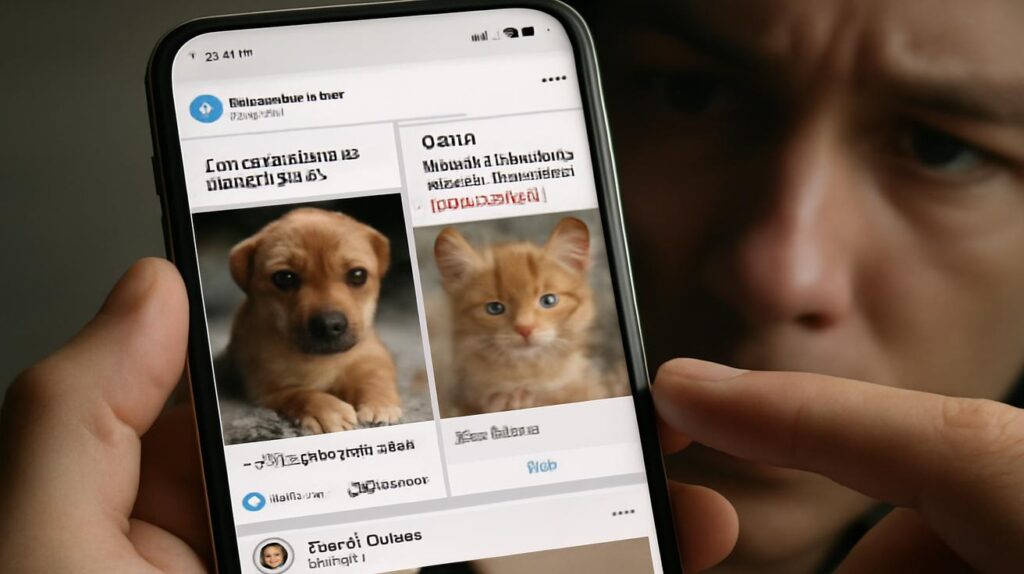
The first thing you notice is the photo: a little boy with dust on his cheeks and eyes too old for his small face, staring straight into your phone screen as if he can see you. “Please don’t scroll past,” the caption pleads. “My brother is dying. We just need one more miracle.” The words curl around your chest like fingers. Your thumb hovers over the donate button. You feel that tiny rush of urgency, of potential goodness: I can help. I can do something. You barely notice the username, the oddly generic page name, the comments that all sound the same. You’re already halfway inside the story.
The New Wilderness of Compassion
We used to think of wilderness as forests, rivers, and mountains—places where getting lost meant moss under your boots and the smell of rain-soaked earth. Now, there’s another kind of wilderness: an endless, glowing river of posts, pleas, and stories sliding under your fingertip. In this digital landscape, the trails aren’t marked by blazes on tree trunks but by hashtags and heart emojis. And somewhere in this wild scroll, scammers have learned to mimic the calls of real need so perfectly that even seasoned wanderers can lose their way.
Charities—real charities—know that numbers alone rarely move us. “One million displaced people” feels abstract; “my daughter hasn’t eaten today” feels like a hand on your arm. Over years, nonprofit storytellers have learned to translate statistics into human stories, to show us a cracked bowl, a hospital bed, a flooded home, and then the next frame: the possibility of change, of recovery, of dignity restored. They’ve learned to speak the emotional language that honors real suffering while inviting real support.
Scammers are listening.
They are not just copying logos or stealing photos anymore. They are studying tone. They are reading the comments under genuine charity posts and making notes about which phrases trigger the most response. They watch what makes you tear up, what makes you click “share,” what makes you whisper “oh no” under your breath at 11:43 p.m. in the glow of your phone. Then they remake that emotional landscape with uncanny precision—except at the end of the path, there is no clinic, no food, no safe house. There is only a bank account with a fake name.
The Anatomy of a Perfectly Crafted Plea
The scams don’t start with clumsy grammar and blurry images anymore. Many look polished, almost tender in their attention to detail. You can feel them trying to mirror the tone of the real thing: humble, urgent, never too pushy, always just on the edge of heartbreak.
A typical scam rescue post often has three key pieces:
- The hook: “Please, I never ask for anything… but I’m desperate.”
- The close-up: a single face, an IV tube, a soot-darkened paw in someone’s hand.
- The countdown: “We have 4 hours before the hospital turns off the machine.”
These pieces aren’t random. They are the scavenged bones of real fundraising stories. Legitimate charities rely on similar structures because they reflect something true: people respond when time is short, when the stakes are high, when the story narrows down from “many” to “one.” We are wired, neurologically, for this kind of intimacy. When you look at a specific face, your brain lights up in patterns of empathy and care. When you see a deadline, your internal clock starts to tick louder.
Scam posts taste this same empathy and copy the recipe. But there is a subtle difference when you sit with them long enough. Real charities often give you a sense of context: where this person lives, who is helping on the ground, what will happen after the crisis. Scams tend to blur the background. Places either vanish into vague phrases—“a small village,” “a war zone”—or they are borrowed from the headlines without any genuine detail. The story becomes a cutout: sharp at the emotional edges, paper-thin behind the eyes.
How Scammers Borrow the Voices of Real Charities
Imagine a room filled with open laptops and dim blue light. On one screen: a well-known children’s hospital’s fundraiser. On another: a local animal rescue posting about an emergency surgery. On a third: a grassroots mutual aid collective asking for rent support for families in the neighborhood. In this room, scammers are not inventing things from scratch; they’re tracing.
They read the comments under real charity posts to see what resonates. They see supporters say, “Sending love to this brave family,” “I wish I could do more,” “Shared, I hope you reach your goal.” Then, they echo this language back to you, sometimes even replying from fake support accounts, stacking the illusion of community like cardboard scenery on a stage.
They copy:
- The rhythm of genuine posts: quiet, then urgent, then grateful.
- The humble tone: “We hate to ask, but…” instead of “Give us money now.”
- The soft-focus hope: “Even $5 can mean the world.”
And instead of raw desperation—which can feel suspicious—they craft a kind of curated vulnerability. There’s just enough messiness to seem real: a typo here, an oddly capitalized word there, a photo that looks like it was taken in a hurry. But behind this scrim of authenticity is an organized operation, sometimes even automated. Some scams run dozens of nearly identical accounts, all swapping out names, faces, and towns but keeping the emotional script almost word-for-word.
Even their gratitude is borrowed. “We are crying reading your messages,” one fake page might say. “You don’t know how much this means,” another writes, minutes after the post goes live, as if hundreds of real donors had already shown up. The emotional weather is artificially set to “heart-wrenching but hopeful” at all times.
When Good Intentions Meet Bad Actors
If you’ve ever donated to something that turned out to be a scam, you probably remember the sinking feeling. It’s not just about the money—though that part stings. It’s the realization that your instinct to help, to lean toward another’s suffering instead of away from it, was used like a lever. The very best part of you was studied, mapped, and pushed for profit.
That betrayal can feel like standing in a familiar forest and discovering that the birdsong you love is coming from a speaker hidden in the branches. You start doubting everything: Is this sound real? Is this story real? Should I look away instead of looking closer?
But the truth is, our compassion is not the problem. The problem is how little time we are given, in the middle of an endless feed, to let that compassion breathe and ask questions. Scammers rely on speed—on tiny, compressed decisions made in half a heartbeat. Scroll, feel, click. No pause. No context. No verification.
Yet the same technology that allows scams to spread like wildfire can also help us slow down. We can search, cross-check, ask others, and pay attention to the patterns that separate real need from manufactured drama. The goal is not to harden our hearts; it’s to sharpen our awareness, so our kindness lands where it’s truly needed.
Signals in the Noise: Telling Real Stories from Manufactured Ones
There is no single silver-bullet test, but there are small questions that act like lanterns in this digital undergrowth. None of them are meant to shame you for being moved. They are here to give your empathy a steady place to stand.
Ask yourself:
- Who is behind this post? Is it a well-known charity, a small local group with a clear identity, or an anonymous page with a name like “Help All Kids Now” created three weeks ago?
- What details are missing? Genuine charities usually provide at least some verifiable information: a region, a hospital name, a partner organization, or a clear explanation of how funds are handled.
- Is there an independent presence? Does this group appear anywhere else online—a basic website, a local news story, a community page—beyond the platform where the post appears?
- What payment methods are offered? A direct personal wallet, anonymous transfer, or only gift cards is a large red flag.
- How does the urgency feel? Real emergencies are urgent, but when every single post screams “minutes left before death” with no updates or follow-up, something is off.
Scammers also often stack emotional language without grounding it in place or process. You see lots of words like “miracle,” “angels,” “heartbroken,” and “unbearable,” but very little about who is organizing the care, what local resources exist, or how long-term help is being coordinated. It’s all climax, no story.
By contrast, genuine organizations usually show a bigger picture. Even in the most desperate situations, they might talk about partners, staff, shelters, clinics, logistics. They might share before-and-after photos or updates that aren’t just “we still need more money,” but “we did this with what you gave us.” The emotional current is still there—this work is real and often painful—but it is rooted in clear, concrete action.
A Pocket-Sized Comparison Guide
Think of the table below as something like a trail map for your feed: quick markers you can glance at before you decide to follow a story all the way to the donate button.
| Aspect | Legitimate Charity Post | Scam Rescue Post |
|---|---|---|
| Identity | Clear name, history, and presence beyond one platform. | Generic page name, new account, little or no history. |
| Details | Specific location, partners, or project info. | Vague setting; missing or inconsistent details. |
| Updates | Regular updates, outcomes, and impact stories. | Repetitive pleas, little follow-up beyond “we still need.” |
| Tone | Emotional but grounded; often includes context and nuance. | Highly dramatic, focused only on crisis and guilt. |
| Payment | Uses transparent platforms, sometimes tax-deductible options. | Pushes for direct transfers, gift cards, or untraceable methods. |
The Emotional Echo: Why This Hurts So Much
Underneath the technical details, there’s something more fragile at stake: trust. Not just trust in charities, but in our own emotional readings of the world. When you find out a post was fake, you might feel foolish, embarrassed, even angry at yourself for “falling for it.” Over time, that can harden into suspicion of everything that sounds like need—every plea, every fundraiser, every trembling story.
Yet there is a quieter danger: that we start demanding a kind of emotional perfection from real people in crisis. Scams teach us to expect drama, tidy arcs of tragedy and redemption, perfectly framed photos. So when someone’s story is messy, unclear, or unpolished—as most real crises are—we might doubt it. We might think, “If this were real, wouldn’t it sound more like that post I saw?” Not realizing that the post we’re subconsciously comparing it to was engineered for impact, not truth.
This emotional echo can ripple out far beyond any one donation. It shapes how we see strangers on the street, how we react to news stories, how we talk to friends going through quiet, less “cinematic” struggles. Scams don’t just steal money; they erode our capacity for unguarded care, grain by grain.
And yet, here is the strange, hopeful thing: the very fact that scammers copy the language of real charities is backhanded proof that this language works. Stories of solidarity, of rescue, of mutual care have power. They move us. They make us open our wallets, yes—but also our imaginations, to a world where we don’t turn away from suffering. That is something worth defending, not discarding.
Keeping Your Heart Soft and Your Eyes Sharp
The challenge, then, is not to shut down our empathy but to pair it with a kind of gentle rigor. Think of it like learning to read tracks on a muddy path. At first, you just see prints. Over time, you begin to notice shape, depth, direction. You can’t always be certain which animal left them, but you get better at telling deer from dog, dog from coyote, coyote from a boot.
In the same way, you can train yourself to notice:
- Phrases that feel oddly familiar, as if copy-pasted between accounts.
- Images that seem recycled, sometimes even reversed or cropped oddly.
- Comment sections filled with generic, repetitive encouragement from accounts that never post anything personal.
- Stories that never shift—no updates, no new angles, no sense of time passing.
When something feels off, give yourself permission to pause. You can still care, still wish the story were true in the best way—that help is on the way—even as you take a breath and look deeper. You can choose to support organizations you’ve researched, local groups you know by name and face, or long-standing charities that may be imperfect but are real.
That pause is not coldness. It’s stewardship of your own compassion. It’s you saying, “My care is precious. I will place it carefully.”
Reclaiming the Story
Somewhere, as you read this, a real aid worker is writing a post they’re not sure how to craft. They’re exhausted, standing under the humming light of a temporary shelter, fingers hovering over their phone. They’re thinking: How do I show what’s happening here without exploiting it? How do I ask for help without sounding like all those fake posts people are tired of?
They might delete their words three times before settling on something simple: a photo of muddy shoes lined up by a cot, a short caption about tonight’s meal, a quiet thank-you to last week’s donors. It may not go viral. It may never cross your feed. But for the people sleeping in that shelter, the story is as real as the blanket pulled up to their chin.
We get to decide what kind of stories we amplify. When we seek out and support real organizations—especially smaller, community-rooted ones—we’re not just moving money. We’re making space online for a kind of storytelling that doesn’t have to compete with scams on drama alone. We’re saying: nuance is welcome here. Context is welcome here. Imperfect, human voices are welcome here.
And when we speak up—reporting suspicious posts, commenting when something feels off, gently warning friends—we’re doing a quiet kind of rescue ourselves. Not of the fictional child in the fabricated ICU bed, but of future donors who might otherwise carry around another bruise of betrayal.
The next time a post stops you mid-scroll, notice the feeling. The tightening in your throat. The ache in your chest. That is not weakness. It is proof that even in this neon, algorithmic wilderness, your heart still responds to the sight of what looks like need. That is a beautiful, living thing. Hold on to it. Protect it. Guide it with care.
Because somewhere, away from the scams and echoes, a real family is waiting for a call back from the hospital billing office. A real rescue worker is carrying a real dog out of a real flooded street. A real small-town mutual aid group is placing grocery bags on real porches. They won’t always have the perfect words. But if we learn to listen closely—past the mimicry and manufactured drama—we can still hear them.
FAQ
How can I quickly check if a rescue or charity post is legitimate?
Look for a clear organization name, a track record of posts, and some presence beyond a single platform. Search the name online, check if local news or community pages mention them, and see if they provide specific details about where and how they work.
Are all emotional charity posts suspicious?
No. Real crises are deeply emotional, and legitimate charities often use powerful stories to reflect that reality. Emotion alone isn’t the problem; it becomes concerning when it’s paired with vague details, new or anonymous accounts, and pressure for fast, untraceable payments.
What should I do if I suspect a post is a scam?
Avoid donating through the links provided. Report the post or account to the platform, take a screenshot if you want to warn others, and, if possible, notify any legitimate organization whose name or images might be misused.
How can I support real charities without getting scammed?
Choose organizations you’ve researched, especially local or well-established ones. Donate through their official websites or recognized fundraising platforms. Consider setting up recurring support for a few trusted groups instead of responding to every urgent post you see.
Is it wrong to feel angry or ashamed after falling for a scam?
Those feelings are natural, but the fact that you cared enough to act is not something to be ashamed of. Scammers exploit good qualities, not bad ones. Use the experience to adjust how you verify stories, but try not to let it harden your heart against people who genuinely need help.