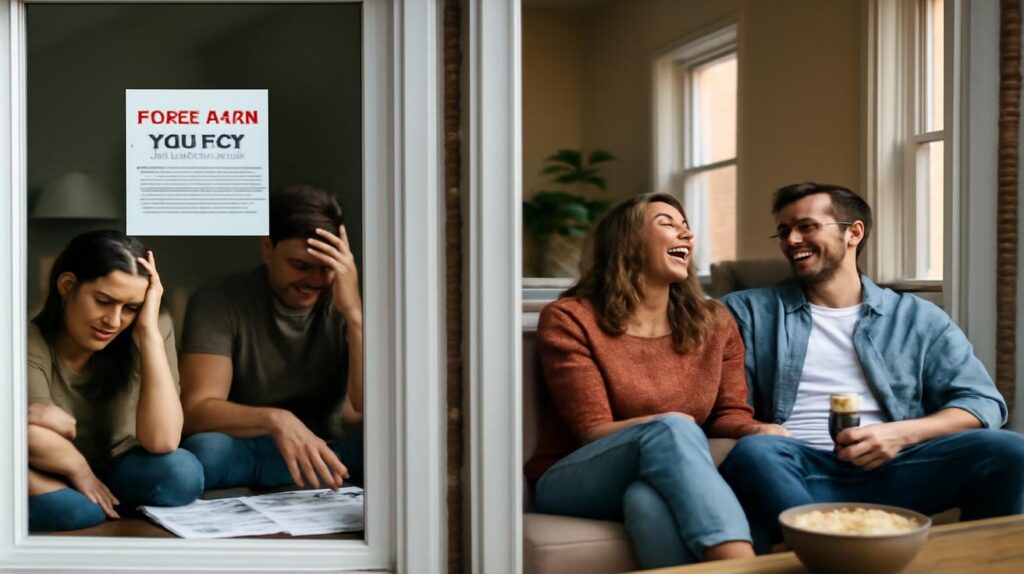
The first house I ever loved had a leaky roof, a maple tree that threw lacework shadows across the living-room wall, and a landlord who could never remember my name. I had a mattress on the floor, a wobbly table by a drafty window, and a key that was very clearly not “mine” in the permanent sense. Yet every evening, when I turned that key and stepped inside, I felt something I’ve never quite felt in any owned place: a strange, light-boned freedom, as if the walls were more like borrowed shelter than a lifetime sentence. Years later, watching friends disappear into thirty-year mortgages and endless renovation debt, I began to suspect something quietly radical: maybe humans were never meant to own homes at all.
The Ancient Nomad in the Lease Agreement
Imagine, for a moment, our distant ancestors staring at a dense forest edge or an open, shimmering grassland. Their homes were skins and woven mats, huts and tents that could be taken down, carried, rebuilt. The horizon, not the property line, was their boundary. Land wasn’t something an individual could “own” any more than they could own a river or a migrating herd. You simply moved with seasons, with opportunity, with danger, with hope.
Now picture us today, rolling a pen over a glossy contract for a thirty-year mortgage. We’re told this is the pinnacle of adulthood, the responsible move. But that same pen signs away decades of optionality: where you can live, what work you can take, whether you can walk away from a city that’s slowly breaking your heart. Somewhere in the tension between our migratory past and our immobilized present, something feels off.
Humans evolved to adapt, to follow the rains, the jobs, the changing climate. The idea that a rational, flexible life should be anchored to one ultra-expensive cube of private shelter is historically bizarre. Housing, as a basic need, makes sense. Housing as a personal trophy asset does not.
When we talk about “the dream of homeownership,” we rarely admit how eerily recent this dream is. For most of human history, land wasn’t a private investment strategy. It was shared commons, territory for a clan or village, or property of rulers and empires—not individual wage-earners gambling future decades on interest rates and neighborhood “comps.” In that long arc of time, lifelong renting—or, more accurately, lifelong borrowing and sharing—was normal. The modern obsession with private deeds is the strange experiment, not the other way around.
The Quiet Violence of the Mortgage Mindset
Of course, owning a home is framed as an act of care: you’re “building equity,” “providing stability,” “investing in your family’s future.” These phrases sound tender and responsible. But baked inside this language is a quiet violence against everyone who can’t or won’t play the same game.
Every time someone stretches beyond their needs to buy more house than they’ll truly use—an extra bedroom “just in case,” a vast yard they barely touch, a garage for things they rarely need—they’re not simply expressing a personal preference. They’re removing that space from the shared pool of possible homes. In a world where housing supply is constrained, that choice ripples outward as rising rents, longer commutes, and overcrowded apartments for others.
Mortgages, especially in hot markets, incentivize people to treat homes less like shelter and more like lottery tickets. If your house is your main financial asset, of course you want prices to rise. Of course you vote against new apartment buildings that might “hurt property values.” Of course you resist zoning changes that would allow more people to live near you, ride your trains, share your parks. You become, almost by design, someone whose economic safety depends on someone else’s exclusion.
Consider how strange this is in any other context. We would find it grotesque if people bought up most of the food supply and then argued politically to keep food scarce so the value of their private pantry would rise. Yet with housing, we nod along and call it “smart.” A mortgage, innocently framed as shelter for one family, becomes a slow-motion act of selfishness—especially when locked in by political resistance to density and rental protections.
How Owning Warps Neighborhoods
Mortgaged ownership also warps how neighborhoods age. Instead of being living organisms that adjust and flex as populations change, they become frozen dioramas: low-density, carefully guarded, suspicious of anything that might introduce rental units, co-housing, or flexible spaces. The result: young people get pushed farther out, workers commute longer, elders rattle around in houses far bigger than they need because selling triggers taxes, emotion, and a loss of that precious “equity.”
In this locked-in system, the house no longer serves the human. The human serves the house—and the bank behind it.
Renting as the More Human, More Honest Way to Live
Against this backdrop, lifelong renting begins to look less like failure and more like a reclamation of our older, more adaptive instincts. Renting says, “I belong to the world, not just this plot.” It says, “I don’t need to hoard square footage to feel secure.” It allows us to move toward opportunity rather than cling to a structure out of fear we’ll lose money if we walk away.
Imagine a city where most people rent, not as a stepping stone to ownership, but as a stable default supported by strong tenant protections and long-term leases. Buildings are owned by cooperatives, non-profits, or public trusts whose mandate is to provide good housing, not maximize shareholder return. You might stay in the same building for twenty years, even pass your lease on to your children. Or you might live in ten different neighborhoods over a lifetime, following jobs, lovers, or the quiet magnet of a particular riverbank or park. Both pathways are valid, equally respected.
In that world, maintenance is not a solitary burden. You’re not alone on a ladder in the rain, trying to repair a roof you can’t quite afford. Teams of professionals maintain and upgrade buildings as part of a shared system, like public transit or libraries. Broken boilers and drafty windows stop being private sorrows and become collective responsibilities.
Most crucially, renting disconnects your personal stability from your neighbors’ desperation. You can want good, safe housing for yourself without needing the number on everyone else’s rent bill to climb for your “net worth” to look better. You stop rooting, even secretly, for exclusion.
The Myth of “Throwing Money Away”
The strongest emotional hook of homeownership is the idea that rent is “wasted” while mortgage payments are “investments.” On paper, this sounds rational. In reality, it’s a half-truth wrapped around a sales pitch.
A mortgage is not a magical piggy bank. It’s a complex bet on a specific neighborhood, a specific country’s political stability, specific interest rates, and a specific roof that will absolutely leak at the worst possible time. You’re trading the flexibility of renting for a highly leveraged, undiversified investment in a single fragile asset: one house, in one town, on one street.
Meanwhile, we quietly ignore all the “rent” embedded in owning: property taxes (rent to the state), mortgage interest (rent to the bank), maintenance and insurance (rent to entropy). The idea that mortgages are purely “building equity” is like saying raising children is purely about future nursing-home care: technically there may be some return, but that’s not the main story, and it’s certainly not guaranteed.
With renting, you pay money to convert the chaos of the housing market into a predictable monthly service: shelter, repairs, some utilities, the ability to leave after a fixed term. That’s not throwing money away. That’s paying to avoid a lifetime of home-improvement YouTube spirals and midnight calls to septic-tank specialists.
When Owning Becomes an Environmental Absurdity
Beyond personal finance, there’s a quieter, ecological argument against a world built on private homeownership. Walk through almost any suburb and notice how much land is sealed off into tiny kingdoms of pride and neglect: over-fertilized lawns here, plastic play structures there, three separate sheds holding three separate sets of rarely used tools. Each household owns its own ladder, its own drill, its own collection of single-purpose kitchen gadgets that appear twice a year.
Now imagine the same number of people living primarily in thoughtfully designed rental buildings. Tool libraries replace a hundred private garages of rusting metal. Communal gardens replace chemically dependent lawns. Shared laundries use less water and energy than dozens of individual machines humming behind drywall. One roof, solar-panelled, shelters dozens of households instead of one or two. The ecological math tilts hard in favor of sharing.
Mortgaged ownership, in its current cultural form, encourages duplication and overbuilding. We build bigger houses than we need because the marginal cost of another spare room feels small compared to the emotional thrill of “owning more.” Those extra rooms require heating, cooling, cleaning, materials, and land—all of which are drawn from somewhere else and someone else. The planet groans; we get a guest room that sees daylight three times a year.
Table: Comparing Lifelong Renting vs. Typical Mortgage Ownership
| Aspect | Lifelong Renting | Mortgage Ownership |
|---|---|---|
| Mobility | High – easier to relocate for work, climate, or community | Low – moving is costly and tied to selling or renting out |
| Financial Risk | Predictable monthly cost; no exposure to housing downturns | Concentrated risk in one asset; market swings can erase equity |
| Community Impact | Less incentive to block new housing; supports flexible density | Incentivized to oppose density to protect property values |
| Maintenance | Shared responsibility; handled by landlords or co-ops | Entirely on the owner; surprise costs common |
| Environmental Footprint | More efficient use of space and resources in multi-unit housing | More sprawl, private lawns, duplicated tools and infrastructure |
The Emotional Story We Tell Ourselves About “Home”
Beneath the spreadsheets and policy debates is something softer: the story we tell ourselves about what a “home” should feel like. For many people, ownership is supposedly about roots, about never having to pack your life into cardboard boxes again, about painting the walls any color without asking permission.
But roots are social, not financial. The people who feel most “at home” in a place are rarely the ones with the biggest deeds. They’re the ones who know the names of their neighbors’ dogs, who attend the same farmers’ market every Saturday, who volunteer at the school, who bike the same riverside path until they can tell you exactly when the cottonwoods leaf out.
You can live ten years in a rented apartment and know the stairs by heart, the particular creak in the third step, the way late-afternoon light reflects off the building across the street to paint a gold triangle on your ceiling. You can become part of the local fabric so deeply that the barista starts your drink before you order, the librarian sets aside books for you, and the person at the corner store asks if you’re okay when you show up quieter than usual.
None of that requires a deed. It requires time, attention, and a willingness to care about a place even if you don’t “own” it. In fact, knowing you’re not the permanent overlord of your patch of earth might make you more careful, more humble. You’re a guest, a steward, a passer-through, like everyone else before and after you.
Security Without Possession
There is, of course, a real anxiety behind the desire to own: fear of eviction, of rent hikes, of a landlord who sells the building out from under you. These are not irrational fears; they’re symptoms of underregulated rental markets and weak tenant protections. But the answer to a broken system isn’t to escape it individually by buying a house—it’s to repair it collectively so no one is one notice away from losing shelter.
Imagine robust rental laws that guarantee long-term leases, transparent rent increases linked to real costs, and ironclad protections against arbitrary eviction. Imagine universal portable benefits, so your sense of security comes from social systems rather than fragile personal wealth. In that world, owning to feel safe looks as outdated as hoarding gold bars in your basement.
Security doesn’t have to mean possession. It can mean trust: in your community, in your institutions, in the knowledge that you will be housed because you are human, not because you won a bidding war.
If Not Ownership, Then What?
Rethinking home as something we borrow rather than own opens space for creative structures that sit between pure renting and traditional mortgages—but still reject the “I alone own this patch forever” mindset.
Cooperative housing, for instance, lets residents collectively own a building, vote on policies, and share responsibility without carving the structure into isolated private fiefdoms. Community land trusts separate the ownership of land from the buildings on it, ensuring the land itself stays in collective hands while residents enjoy long-term, affordable leases. Public housing—when funded, designed, and managed with dignity—can outcompete the private market on quality, stability, and ecological efficiency.
Even within conventional rentals, there’s room for cultural shift. Long-term leases can replace precarious year-to-year agreements. Rent-to-stay models could reward stability without forcing tenants into ownership. Cities could incentivize landlords who maintain units as high-quality, long-term homes rather than speculative flip opportunities.
The thread through all these ideas is the same: housing as a service and a right, not a status symbol. A roof as a shared human project, not a private stock ticker.
Letting Go of the House as Identity
When you strip away the mythology, a house is just a tool—a sheltering shell against weather and loneliness. Yet we’ve wrapped so much identity into “owning” that to question it can feel like a personal attack. If I don’t own, am I less grown-up? Less successful? Less safe?
But a different image of success is waiting quietly in the wings: the person who lives lightly, moves when life calls, doesn’t cling to square footage as proof of worth. The person whose pride comes from their relationships, their craft, their contributions, not the resale value of their kitchen countertops.
In that vision, lifelong renting isn’t a consolation prize. It’s a deliberate choice: to stay nimble, to minimize harm, to refuse to link your thriving to someone else’s scarcity. It’s a way of saying, “I want a good life, but not at the cost of making housing into a battlefield where my win is your loss.”
Frequently Asked Questions
Isn’t buying a home still the best way to build wealth?
It can be a way, but it’s not inherently the “best” or most rational. It concentrates risk in one asset, ties you to one place, and often assumes continuous price growth that isn’t guaranteed. Diversified investments, combined with stable renting, can offer similar or better long-term security without sacrificing mobility or contributing to housing scarcity.
What about the emotional security of knowing you can’t be evicted?
That feeling is valid, but it shouldn’t require a mortgage. Strong tenant protections, long-term leases, and fair rental laws can provide comparable security. Pushing everyone toward ownership as the only path to stability lets governments off the hook for creating a just rental system.
Are renters less invested in their communities?
Not inherently. Investment in a community comes from time, care, and participation, not a deed. Many long-term renters are deeply rooted in their neighborhoods. Structures that support stable renting—like multi-year leases and community-led buildings—encourage this even more.
Is owning a home always selfish?
Intentions vary, but in a constrained housing market, private ownership beyond your genuine needs often has selfish effects, whether or not that’s your goal. Choosing smaller spaces, supporting density and tenant rights, and avoiding speculative “property ladder” behavior can reduce the harm, even for those who do own.
What would a society built on lifelong renting actually look like?
It would likely feature strong tenant protections, a large stock of high-quality rental housing, co-ops and land trusts, and cultural norms that treat renting as a dignified default, not a temporary failure. People would move more freely, housing would be used more efficiently, and your sense of home would come less from a deed and more from your relationships and routines.