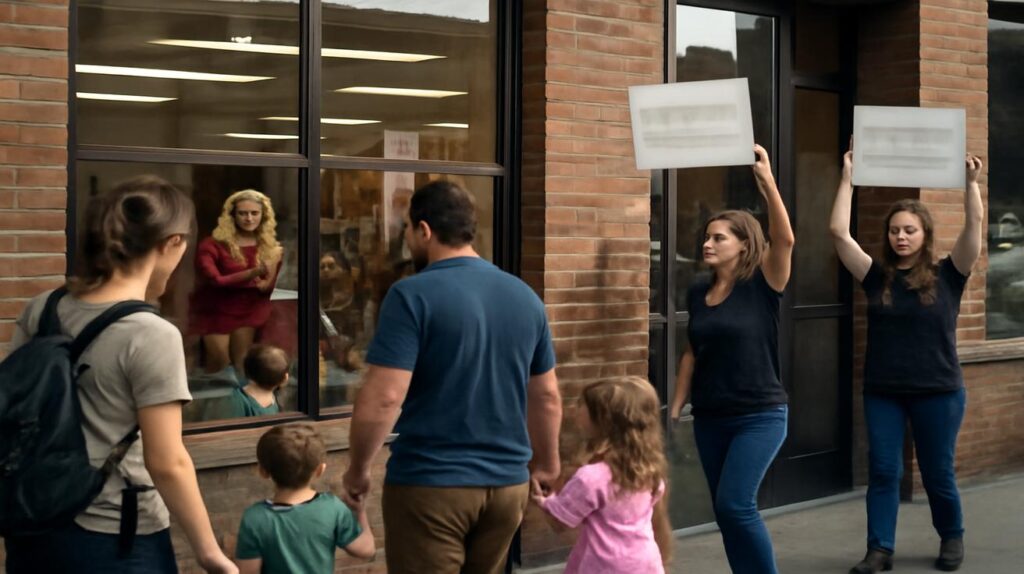
The boy in the dinosaur hoodie freezes halfway to the picture books, his small hand suspended in midair. At the front of the public library’s children’s room, a tall figure in sequined heels and shimmering blue lipstick bends toward a circle of kids. A tiara glints. A storybook opens. Parents hover at the edges with coffee cups and folded arms—some smiling, some filming, some tight-lipped and ready to bolt if the next sentence crosses a line they can’t accept. This is “Drag Story Hour,” and for a growing number of families, it has become the line in the sand: a simple, glittery storytime to some; the front door of a new civic religion to others.
Where the Playground Meets the Culture War
Most parents don’t wake up wanting to wage a philosophical battle before breakfast. They wake up wanting their coffee hot, their kids safe, and the world waiting outside the front door to be at least somewhat predictable. Yet lately, that world seems full of abrupt new invitations: drag story hours at the library, classroom lessons about neopronouns and nonbinary identities, school blueprints replacing “boys’ room” and “girls’ room” with all-gender bathrooms.
To some, these are overdue corrections—tiny nudges toward a world where kids who don’t fit the old molds no longer have to hide or suffer in silence. To others, they feel like mandated experiments, cooked up by elites who assume that “inclusive” means “mandatory” and who treat parental reservations as relics of a dying, bigoted past.
So the question simmering under school-board shout-fests and library protests is less about any single event and more about boundaries: How far is too far for diversity of gender expression in public spaces? Should every family be effectively required to participate in a new culture of visibility and affirmation—or do parents hold a moral right to say, “Not for my kids, not right now,” even if that looks to some like carving out modern “bigot zones” where the latest wave of progress is politely kept outside the door?
Whose Public Space Is It, Anyway?
Public spaces—libraries, schools, parks, city halls—are supposed to belong to everyone. That sounds noble until you actually look at “everyone.” A single elementary school already contains a miniature universe: kids with two moms, kids whose dads voted for policies that deny those moms legal recognition, kids who feel at home in their gender, kids who don’t, kids whose religious codes are strict, kids whose homes are loose and experimental.
We talk about “the public” as if it were a single, unified body. It never has been. When we decide what belongs in those shared spaces—what’s displayed, what’s taught, what’s celebrated—we’re really answering a more delicate question: whose discomfort matters most?
The parent who pulls her child away from a Pride-themed display may see herself as defending her family’s right not to have moral norms reshaped by whoever designs the bulletin board. The trans teen who finally sees a book with a character like them on that same display experiences it as oxygen. Take it down, and they read that erasure as a quiet message: you are too controversial to exist in public.
So drag story hours and neopronoun lessons aren’t just about surface-level issues. They’re about what counts as neutral in our public square—and whether “neutral” is even possible.
Drag Queens, Storybooks, and the Edge of Comfort
When drag performers read to children, the reaction often splits along an invisible fault line: one side sees play, the other sees indoctrination.
In supportive circles, drag story hours are framed as a joyful mash-up of costume, theater, and reading. If Disney princesses can visit the library, why not a queen in a gown made of sequined sunflowers? For kids who already know queer or gender-nonconforming adults, this looks like simple belonging—an affirmation that people who look like their uncle, their babysitter, or sometimes like themselves, are allowed to be visible and loved.
Across the room, another parent watches the same performance and feels something more intrusive. They remember when public storytime meant fables, alphabet books, or maybe a light moral about sharing. Now, it feels—to them—like an announcement: This is the new normal, and your hesitations belong to the past. The glimmering clothes and playful jokes become, in their mind, symbols of a broader project: blurring boundaries they consider sacred, folding their child into an ideology they did not choose.
It’s possible, of course, that both sides are partly right. Drag has historically been subversive, a gleeful poking at gender norms, sometimes with adult humor baked in. When you bring that aesthetic into a children’s program, you are sending a message—whether you intend to or not—about what’s acceptable in public life. But failing to bring it in also sends a message, especially to queer kids: your existence, and how you express it, must remain smaller, quieter, farther from the story circle.
That double-bind is what makes simple solutions hard. If you cancel drag story hours entirely, some children lose a rare place where they can see that vibrant difference belongs. If you normalize them everywhere, you ignore the sense of violation felt by families who experience this as an unwanted moral curriculum with feathers and false eyelashes.
Neopronouns and the Classroom: Learning or Litmus Test?
In some schools, the conversation has moved from “he or she” to a more expansive menu: they/them, ze/zir, fae/faer, and a rotating cast of neopronouns that sound, to many older ears, like words from a fantasy novel. To a student who struggles every time someone calls them “he” or “she,” these new terms promise a better fit—and, more importantly, a sense of being recognized.
To the teacher trying to navigate it all, it can feel like walking a tightrope over a canyon of outrage. Use the wrong pronoun, and you’re accused of harm. Suggest that maybe not every invented word deserves space on a vocabulary quiz, and you’re told you’re invalidating a student’s “true self.”
Parents watching from outside the classroom may see these trends as a bridge too far. The old grammar rules they grew up with—pronouns tied to observable sex, singular “they” limited to anonymity—are being rewritten faster than they can keep up. They worry less about the emotional needs of specific kids, and more about a creeping sense that language itself is being conscripted into a belief system: one that says inner identity always outranks bodily reality, and that dissent from this view is morally suspect.
So when a school program includes lessons about neopronouns, some parents bristle. Is this teaching kids to be kind and flexible, or teaching them that only one philosophical map of gender is acceptable? Is it a vocabulary lesson or a subtle loyalty oath?
The heart of the tension isn’t whether we should teach children to respect others—almost everyone agrees on that. It’s whether respect now requires enthusiastic agreement with the idea that gender is infinitely customizable and that every variation demands the full weight of institutional affirmation.
Bathrooms, Safety, and the Architecture of Inclusion
Bathrooms might be the least glamorous battleground in the culture war, but they’re one of the most visceral. The sign on a restroom door is more than a label; it’s a tiny, daily choice about whose comfort we prioritize.
Gender-neutral bathrooms are pitched as a simple solution: everyone uses the same facilities, often with private stalls and shared handwashing areas. In practice, they’re a patchwork. One school might convert single-stall restrooms to all-gender use with minimal fuss. Another might reassign big, multi-stall rooms and watch rumors and anxieties bloom in their wake.
For a nonbinary or trans kid who has spent years holding their bladder to avoid harassment, an all-gender restroom can feel like a lifeline. For a parent whose daughter reports a strange boy in the next stall—or even just fears the possibility—the same arrangement feels reckless. Even if the threat is mostly imagined, the fear is not, and fear is politically powerful.
Public institutions often end up with half-measures: keep the traditional boys/girls restrooms, add a single all-gender option, and hope the compromise satisfies everyone. It rarely does. Advocates argue that relegating gender-diverse kids to “special” bathrooms reinforces stigma; critics argue that changing longstanding norms for everyone because some individuals don’t fit tidily in the boxes is an upside-down approach.
Again, both sides are navigating real concerns: safety, dignity, privacy, and the ever-present worry that a wrong decision might devastate a child’s sense of self—or expose them to real harm. The weight of those stakes makes every sign on every bathroom door feel like a referendum on whose reality the institution believes.
The Invisible Table: What We’re Really Arguing About
Underneath the shouting about drag queens, pronouns, and bathrooms lies a quieter dispute about power: Who gets to set the default? Whose values are treated as the starting point, and whose are framed as deviations that must either be corrected or “tolerated” reluctantly?
Think of the public square as a big invisible table where rules are written. For a long time, that table was dominated by assumptions that lined up with traditional, often religious, models: two genders, fixed roles, heterosexual norms. People who didn’t fit those models—queer people, trans people, gender-nonconforming people—were allowed at the table, if at all, mostly on the condition that they kept quiet about it.
Now, the table is being rearranged. The seat once reserved for rigid binary gender is shared with newer voices insisting that self-identification matters more than biology, that visibility matters more than comfort, that inclusion must be active and vivid rather than neutral and shy. Those who once felt marginal now push for institutions to reflect their reality front and center.
To parents who see these changes as overdue justice, the discomfort of others is the price of progress—much like the discomfort of racists when schools desegregated. To parents who see them as overreach, the push for ubiquitous gender inclusion feels less like civil rights and more like a mandatory catechism: repeat after me, believe as we do, or be marked as morally suspect.
That’s where phrases like “civic religion” sneak into the conversation. When every poster, assembly, and bulletin board seems to carry a singular, non-negotiable account of gender and identity, families who don’t share that account feel not just outvoted, but morally indicted.
Do Parents Have a Right to Say “Not for Us”?
So what about that moral right to shield children? Is there space, in a pluralistic society, for parents to say: “We don’t want drag story hours in our library’s children’s room,” or “We don’t consent to neopronoun instruction for our third-grader,” without automatically being branded bigots?
Legally, it’s complicated and varies by region. Morally, it’s even messier.
On one hand, parents are usually the first guardians of their kids’ moral and psychological worlds. They curate what media comes into the house, what religious or philosophical teachings are passed down, what kinds of conversations are “for later.” This gatekeeping is not only normal—it’s inevitable. Every family filters, choosing some influences and declining others, hoping to buy time until their kids are ready for the full chaos of the wider world.
On the other hand, there’s a long and painful history of “shielding children” being used as a rationale to erase or harm minorities. Once upon a time, exposing a child to an interracial couple or a same-sex relationship was framed as a dangerous ideological experiment. Many Black, gay, or otherwise marginalized adults still remember being the “thing” other parents wanted to keep their kids away from.
The ethical crux is this: Where is the line between protecting your child from ideas you believe are false or harmful, and demanding that others disappear from public life so your child doesn’t have to see them?
Refusing to attend a drag story hour is one thing. Campaigning to have them banned altogether, even in communities that want them, is something else. Opting your kid out of a lesson is one thing. Trying to make sure no child can ever encounter neopronouns in public school corridors—that’s a demand that other families’ realities remain permanently unacknowledged in common spaces.
Still, progressives sometimes underestimate the sense of cornering many parents feel. When every concession is framed as simply the bare minimum of decency, it can start to feel like the only acceptable end point is total surrender of their own beliefs. That’s when the idea of “bigot zones” creeps in—enclaves, literal or psychological, where people can hold the door against new norms and say, “Inside here, we’re doing things our way.”
Can We Live with a Patchwork?
There’s a certain easy cruelty in pretending we can design a single national standard that will satisfy both the parent who wants drag story hour banned and the parent whose queer child only feels safe in a world where drag queens read aloud without protest. The United States—and many other countries—are not moral monocultures. They’re messy, improvised patchworks.
In practice, that often means local variation. Some libraries will host drag story hours; some won’t. Some schools will adopt expansive pronoun policies; others will move more slowly. Families who find their local institutions intolerable may move, homeschool, or cluster in communities where their values dominate. It’s not elegant, and it risks deepening polarization, but it also reflects reality: we are not, at present, a culture that agrees on a single moral map of gender.
Yet there are a few principles that might keep the patchwork from tearing completely:
| Principle | What It Looks Like in Practice |
|---|---|
| Transparency | Clear notice about events and curriculum (drag story hours, pronoun lessons, bathroom policies) so families aren’t blindsided. |
| Opt-outs with Limits | Reasonable ways for parents to excuse their kids from certain activities without shutting those activities down for everyone. |
| Dignity for Minorities | Ensuring that trans, nonbinary, and queer kids can exist safely and visibly, even in communities that don’t fully affirm their worldview. |
| No Forced Conversions | Resisting both the urge to impose a single “traditional” answer and the urge to require public declarations of allegiance to any ideology. |
| Curiosity over Caricature | Teaching kids how to ask honest questions and sit with differences, rather than feeding them simple heroes-and-villains scripts. |
The alternative is a zero-sum game where every storytime and restroom sign becomes not a shared solution but a conquest—a way of proving who owns the future.
Between Shielding and Seeing
In the end, the boy in the dinosaur hoodie inches a little closer to the story circle. The drag queen on the low chair turns a page, her false eyelashes blinking theatrically as she reads about a frog who doesn’t know quite where he belongs. Some kids fidget. Some parents relax. At least one pulls out a phone and scrolls, no doubt half-ready with a post about either courage or corruption.
The story will end. The kids will spill out into the parking lot. The sequins will be zipped into a garment bag. Somewhere else, in another town, a school board will argue late into the night about pronoun policies or bathroom signs. Behind almost every opinion at those meetings lies a child: a trans kid who has been bullied to the brink; a devout kid who feels the world is dissolving; a shy kid who just wants to read dinosaur books in peace.
Maybe the real task is not to settle, once and for all, how far is “too far” for gender diversity in public spaces. We are unlikely to agree on that anytime soon. Perhaps the task is humbler and harder: to admit that other people’s fears and hopes are as real as our own, that a world where your child never has to confront what you find wrong might require someone else’s child to disappear.
Between forcing every family to adopt a new civic religion and allowing every family to retreat into fortified “bigot zones,” there is a narrow path. It winds through awkward compromises, local experiments, transparent policies, and a shared refusal to let any child become only a symbol in someone else’s culture war. On that path, shielding is not absolute, and inclusion is not all-or-nothing. Kids encounter difference, yes—but with adults nearby who can say, with honesty, “Here is what we believe, here is what others believe, and here is how we treat people with care, even when we do not agree.”
It’s not tidy. It won’t make everyone happy. But for a generation of children watching adults fight over who gets to sit at the story circle, it might at least model a better story: one where public spaces are neither sanctuaries from all difference nor stages for compulsory enlightenment, but shared rooms where we learn—sometimes clumsily—how to live together without requiring each other to vanish.
Frequently Asked Questions
Are parents legally required to take kids to drag story hours?
No. Attendance at drag story hours is typically voluntary, like any other library program. The controversy usually centers on whether such events should be hosted in public institutions at all, not on forcing specific families to attend.
What is a neopronoun curriculum in schools?
A neopronoun curriculum refers to lessons or materials that teach students about pronouns beyond he/she/they, such as ze/zir or fae/faer. In many places, this is not a formal “curriculum” but part of broader discussions about respecting classmates’ chosen names and pronouns.
Do gender-neutral bathrooms replace all boys’ and girls’ restrooms?
Most commonly, gender-neutral bathrooms are added alongside existing boys’ and girls’ rooms or created from single-stall restrooms. Completely replacing all gendered facilities is less common and often generates significant local debate.
Is it inherently bigoted for parents to be uncomfortable with these changes?
Discomfort alone does not automatically equal bigotry. People’s reactions are shaped by culture, religion, and experience. The moral question is what we do with that discomfort—whether we use it to seek understanding and workable compromise, or to demand that others disappear from public life.
Can schools respect gender-diverse students without pushing a specific ideology?
Many educators aim for this balance by focusing on practical respect—using students’ names and pronouns, preventing bullying, and providing private bathroom options—while avoiding demands that every student adopt a particular philosophical stance on gender. The success of this approach depends heavily on local culture, training, and trust between schools and families.