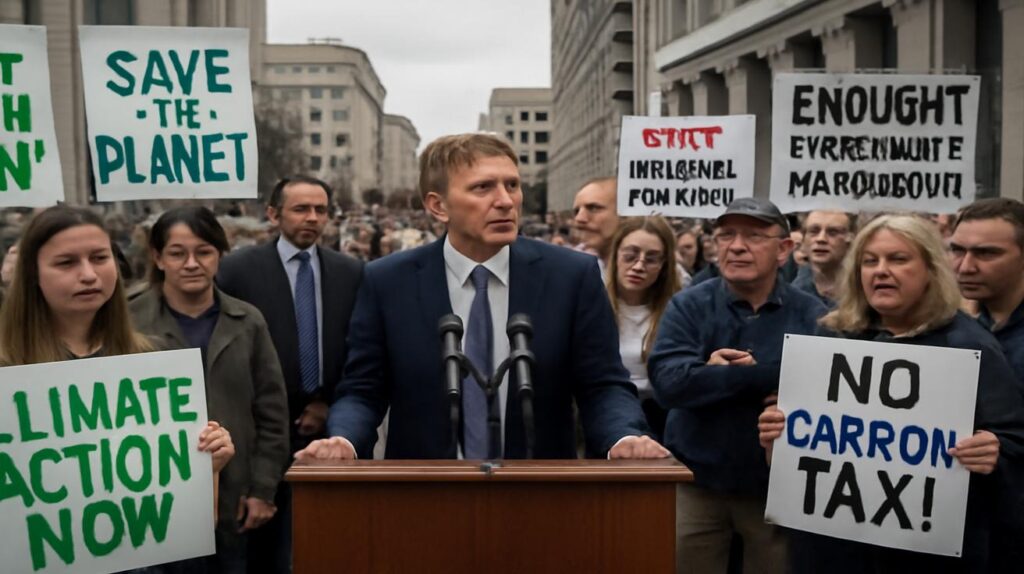
The rain begins just as the prime minister’s voice rises on the giant screen, drops spattering the plastic chairs of the city’s “Climate Action Festival.” Children in recycled cardboard crowns chase each other between stalls selling bamboo toothbrushes and oat-milk lattes for the price of a modest lunch. Above it all, a banner snaps in the wind: “Net Zero or Zero Future.” You stand there, half-listening to the speech beamed in from a glossy summit somewhere sunlit and far away, and the same uneasy question nags at you: When did saving the planet become a war I never signed up for, but am somehow paying for every single day?
The new holy war of carbon
The story of climate change used to be simple: the planet is warming, humans are a major cause, and we need to fix it. Straightforward, frightening, urgent. But somewhere between the scientist’s data and the politician’s podium, that story mutated into something more absolute, almost religious—complete with heretics, high priests, and indulgences sold to absolve the rich.
Listen to the language that now hums constantly in the background of our lives: “code red for humanity,” “tipping points of no return,” “collapse of civilization.” The metaphors are apocalyptic, the timelines ever shorter, the tone increasingly unforgiving. It’s not “we should reduce emissions because it’s prudent”; it’s “we have eight years to completely transform our societies or face the end of everything.”
This is what critics call climate alarmism—not the recognition that climate change is real and serious, but the insistence that only the most extreme, immediate, and sweeping responses are morally acceptable. Nuance becomes betrayal. Asking detailed questions about costs, trade-offs, or unintended consequences is recast as moral failure, a kind of quiet complicity with disaster.
That shift in tone matters, because alarm has a particular political chemistry. When people are placed in a permanent state of emergency, democratic debate feels like a dangerous delay. Complexity is framed as sabotage. And into that charged space step the unlikely heroes of our tale: billionaire eco-messiahs, eager politicians, and the ordinary taxpayers whose wallets, homes, and habits become the battlefield.
Enter the billionaire saviors
If every great crisis needs its savior, the climate story has found a pantheon of them in private jets and cashmere hoodies. Their biographies are familiar: self-made tech moguls who conquered software, social media, or online shopping and then gazed up, decided Earth was broken, and that they—armed with money, vision, and a well-funded foundation—would fix it.
They arrive at climate conferences like visiting royalty: stepping off chartered aircraft into fleets of electric limousines, walking past posters urging ordinary citizens to “fly less” and “consume consciously.” They sponsor think tanks, bankroll NGOs, and invest billions into green technologies that will, not coincidentally, likely make them even richer if regulations nudge the world in the right direction.
On glossy stages, they speak in the language of destiny and disruption. We’re told that fossil fuels will be obsolete within a decade, that entire industries can be rebuilt if only we “believe in innovation,” that sacrifices made now will be rewarded with cleaner air, greener cities, and, conveniently, untold profits in the markets they are already quietly cornering.
To be fair, some of what they champion is genuinely promising. Solar power is cheaper than ever; batteries are improving; insulation, heat pumps, and efficient appliances really can slash energy use. The problem isn’t that billionaires are involved. The problem is how their visions—turbocharged by lobbyists and PR—can become the only visions leaders are willing to hear.
When billionaires pour money into climate roadmaps, it’s easy for governments—short on expertise and long on ambition—to treat those glossy blueprints as destiny rather than as proposals. Techno-utopian dreams leak into law. Regulation starts to look suspiciously like market design for future green empires. And somewhere at the bottom of this glittering pyramid stands the person whose household bills are quietly swelling to fund it all.
The quiet conscription of ordinary people
You weren’t asked before fuel duties rose. Nobody rang your doorbell to get your consent before your electricity bill sprouted an extra line for “climate levies.” No one sought your opinion when your town’s only affordable grocery store lost its parking spaces to meet “emissions targets,” making life harder for people who can’t afford to live close enough to walk.
Climate policy, in theory, is about the global commons. In practice, it’s a complicated system of invisible transfers—of costs, risks, and opportunities—from some groups to others. Take a walk through typical climate measures in an average industrialized country, and the pattern becomes uncomfortable.
| Policy Tool | Who Pays Most? | Who Gains Most? |
|---|---|---|
| Carbon taxes on fuel | Commuters, rural households, small businesses | Government revenue, urban elites with alternatives |
| Subsidies for EVs and solar panels | All taxpayers and energy consumers | Wealthy homeowners, green tech investors |
| Strict building & heating standards | Renters, low-income homeowners, small landlords | Construction giants, insulation & tech firms |
| Bans on older cars / low-emission zones | Owners of older vehicles, tradespeople | Car manufacturers, wealthy early adopters |
Each of these policies may have a climate justification. Some may well be necessary. But the distribution of pain and gain is rarely part of the public conversation. Instead, the message is kept high and moral: “We must all do our part.” “There is no alternative.” “History will judge us.” Meanwhile, the actual spreadsheet of who pays remains obscure, technical, buried in legislative detail.
The result is a quiet kind of conscription. You may not wear a uniform or march in parades, but your life is nonetheless being reorganized to serve a war for the planet that no one remembers being openly declared, let alone democratically endorsed in its present, maximalist form.
When urgency turns into a kind of green tyranny
There’s a phrase that circulates at climate conferences: “The science is clear.” It’s used as a moral trump card, a way of short-circuiting debate. But science, by its very nature, is rarely “clear” in the way politics wants it to be. It deals in probabilities, ranges, scenarios, confidence intervals. It can tell us that the planet is warming, that human activities are the main driver, that risks rise sharply if temperatures exceed certain thresholds. It cannot, on its own, dictate our political choices.
Yet that is increasingly how it is invoked. Models are turned into mandates. Worst-case projections harden into the only acceptable lens. Precaution, a wise principle, inflates into prohibition. Technocratic councils and international panels—unelected but draped in the authority of expertise—exercise growing soft power over national policies.
In this environment, politicians discover something intoxicating: the ability to govern by emergency. Once climate is declared an “existential threat,” almost any measure can be sold as necessary, any dissent recast as denial. Want to restructure the energy market overnight, regardless of supply shocks? Climate. Want sweeping new powers over land use and transportation? Climate. Want to subsidize favored industries into existence while phasing out others before alternatives fully exist? Climate.
None of this requires a smoke-filled backroom conspiracy. It just needs a set of conditions: high public anxiety, moral absolutism, and elites who are convinced that history will forgive any overreach committed in the name of survival. The danger is not that climate policy exists—it must exist—but that it drifts from democratic accountability into a kind of green technocracy where ordinary citizens are treated as obstacles to be managed rather than participants to be persuaded.
The war nobody voted for
Listen closely to how leaders now talk about the climate crisis, and you’ll notice the language of warfare woven through nearly every speech. “Mobilization.” “Front lines.” “All hands on deck.” “Total transformation.” It’s the rhetoric of a society shifting from normal politics to something more like a permanent emergency footing.
But traditional wars, for all their horror, usually come with at least the appearance of public consent. Parliaments debate. Declarations are signed. War aims, however manipulated, are openly framed. With climate, the shift has been more subtle, creeping forward policy by policy, target by target. One election cycle you vote for a party promising “strong climate leadership.” A few years later you discover that this has come to mean you may not be able to replace your gas boiler, drive your old car into town, or afford heating without state-approved technologies installed by approved contractors.
Ask people what they actually signed up for, and the answers are far more modest: cleaner rivers, less smog, energy systems that don’t poison the air or depend on hostile petrostates. Few voted for the specific bundle of regulations, bans, and lifestyle re-engineering that “net zero by 2050” is now being interpreted to demand.
That gap—between broad consent for climate action and the narrow, often top-down toolkit deployed in its name—is where resentment flourishes. And that resentment, if ignored, risks producing something even worse than slow climate action: a populist backlash that sweeps away not just overreach but the sensible, necessary parts of climate policy too.
Between denial and doom
So where does that leave us? Trapped, it seems, between two unsatisfying extremes. On one side, climate denial or indifference, often funded by old fossil-fuel interests who still whisper soothing myths that nothing really needs to change. On the other side, climate alarmism, which insists that only the most radical immediate overhaul of society will do, and that those who question the terms must be shamed as cowards or traitors to the future.
But there is a vast middle ground between denial and doom, and most ordinary people intuitively live there. They accept the basic science. They feel the changing seasons, see the shifting patterns of storms and fires. They want cleaner technologies, resilient infrastructure, a planet their children can thrive on. At the same time, they want fairness, transparency, and choice. They want to be asked, not conscripted. They want to be leveled with, not preached at from a private-jet podium.
In this middle ground, the conversation sounds different. It is less about salvation and sin, more about trade-offs and timelines. It asks uncomfortable but necessary questions:
- How do we phase down fossil fuels without collapsing energy security for poorer households and fragile regions?
- What mix of public and private investment actually delivers the biggest emissions cuts per dollar, rather than the biggest headlines?
- How do we ensure that the costs of transition do not fall hardest on those with the least ability to bear them?
- What level of risk are we willing to live with, and what sacrifices are we genuinely prepared to make in exchange?
These are not questions that can be answered by billionaires in boardrooms or by scientists alone. They demand politics in the fullest, most democratic sense: argument, disagreement, revision, compromise. They require admitting that we don’t have a single silver bullet, just a messy arsenal of partial solutions and second-best options. They require a climate movement less enamored of grand historical arcs and more attentive to the daily realities of families choosing between heating and groceries.
Rewriting the terms of the fight
Imagine a different kind of climate politics. Not a crusade led from above by billionaires and technocrats, but a process built from the ground up. Town-hall assemblies where climate budgets are debated alongside school funding and health care. Citizens’ juries weighing the real costs and benefits of local measures, from low-emission zones to rooftop solar mandates. Transparent accounting that shows, in plain language, who pays, who gains, and how compensation will work.
Imagine climate targets that are firm but flexible, updated in the open as technologies and realities change, rather than carved into stone tablets and defended as doctrine. Imagine admitting that some beloved green ideas simply do not work as well as hoped, and that clinging to them because they are fashionable wastes precious time and money.
Most of all, imagine a climate story in which ordinary people are not cast as sinners to be disciplined or soldiers to be ordered, but as co-authors. A story that speaks not only of sacrifice but of tangible improvements: warmer homes that cost less to heat, cleaner buses that actually show up on time, energy systems that keep the lights on in storms, new industries rooted in regions long abandoned by globalization’s winners.
None of this erases the gravity of the climate challenge. The atmosphere does not negotiate, and physics does not care about our political fatigue. The risks of inaction—or grossly inadequate action—remain profound. But the notion that only maximalist, alarm-driven policy can save us is a false dilemma. Between complacency and coercion lies responsibility: serious, sober, humane.
Maybe the real choice is not “green tyranny or last chance for Earth,” but whether we allow fear to be the only fuel of our politics. A future worth living in will not be built by panic, nor by the self-congratulating dramas of billionaire eco-messiahs, but by millions of quieter decisions made in daylight, with eyes open, wallets visible, and consent continuously renewed.
Frequently Asked Questions
Is climate change real, or is it just a political tool?
The underlying science is clear that the planet is warming and human activities are a major driver. Climate change is real. At the same time, real problems can be used as political tools. Concern about climate can be exaggerated, simplified, or framed in ways that justify particular agendas, just as happened with past issues like terrorism or financial crises.
What do people mean by “climate alarmism”?
Climate alarmism is not acknowledging climate risks; it’s the tendency to present only worst-case scenarios, insist on drastic measures without open debate, and label any questions about costs or practicality as immoral or “denialist.” It turns a serious issue into an all-or-nothing emergency that can shut down democratic discussion.
Are billionaire “green” investors helping or harming?
They are doing both. Their money and influence can speed up development of useful clean technologies. But they also shape which solutions get attention, and can profit from regulations that favor their investments. The problem is not that they act, but that their visions sometimes dominate policy without ordinary citizens having a real say.
Why do climate policies often feel unfair to ordinary people?
Many climate measures raise the cost of energy, transport, or housing in ways that hit lower- and middle-income households hardest. Subsidies and incentives often go to those who already have capital—homeowners, large firms, early adopters—while the bills are spread across everyone’s taxes and bills. Without careful design and compensation, the transition can deepen inequality.
Can we tackle climate change without “green tyranny”?
Yes, but it requires more transparency and participation. That means openly discussing trade-offs, showing who pays and who benefits, involving citizens in decisions, and adjusting policies when they prove too costly or ineffective. Climate action can be firm without being authoritarian, if it is rooted in consent rather than fear and moral bullying.