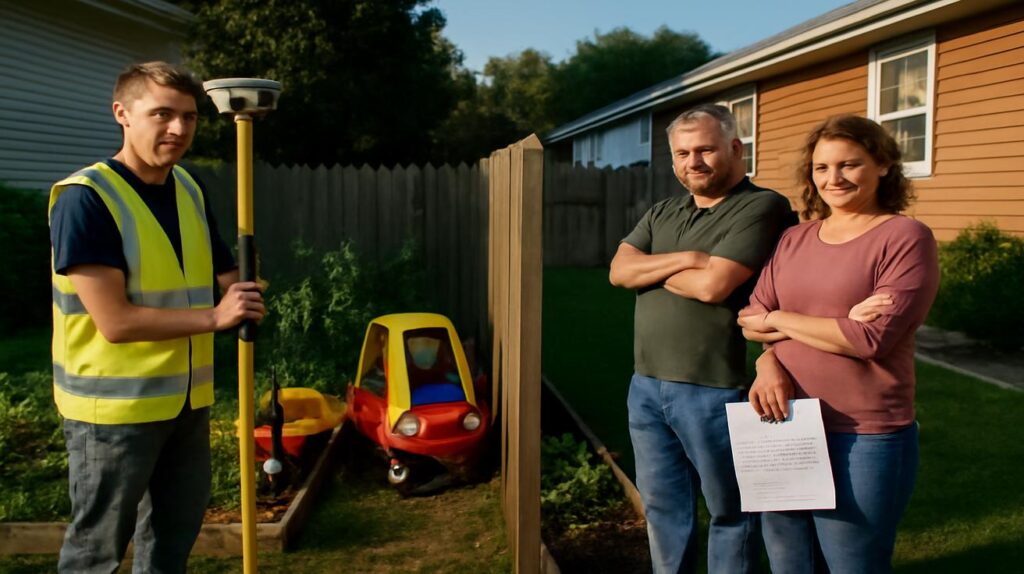
The first thing you notice is the sound. Not birdsong, not traffic, but voices—raised, fraying at the edges—spilling over a fence half-smothered in ivy. On one side, a woman in muddy boots clutches a trowel; on the other, a man in a freshly ironed shirt grips a folded letter that looks too crisp for soil and weather. Between them, a narrow brick path and a gate that has swung open and shut a thousand times without anyone thinking twice. Now that gate is a battlefield. Who owns it? Who is allowed to use it? And when did a humble garden passage become a legal frontier?
The Secret Life of Shared Gardens
Garden access disputes almost never start with a lawyer. They start with something small and almost silly: a potted rose creeping a little too close to a shared path, a bike leaned against a wall that technically, maybe, might belong to the neighbor. For years, everyone shrugs and makes do. You step around the rose bush. You move the bike. You slip through the gate with a nod instead of a written agreement.
Then something changes. Someone moves out and a new owner arrives with a different idea of “neighborly.” A hedge becomes a solid fence. A casual “Sure, use the gate whenever,” fades into “Well, I never said you could always use it.” And suddenly, the old understandings—those unwritten pacts held together by tea, shared seedlings, and borrowed wheelbarrows—are no match for a phrase printed in stark black ink: “right of way not included.”
Law, at its heart, is supposed to be tidy. Land is divided into parcels. Boundaries are drawn. Ownership papers are filed, registered, stamped. But gardens aren’t tidy. They creep, they spread, they blur. A path worn by decades of footsteps doesn’t ask whether it passes over your land or mine; it just remembers that people walked this way and continues to invite them.
That’s why so many garden access disputes turn into quiet dramas about “use” versus “ownership.” One person holds a title deed. The other holds history, habit, and a thousand afternoons walking to a compost bin or hanging laundry out to dry. And when those collide, the garden—this place we think of as peaceful refuge—becomes a place where words like “easement,” “trespass,” and “adverse possession” suddenly feel as real as soil under the fingernails.
When a Path Becomes a Promise
Picture a lane behind a row of terraced houses. To anyone passing by, it’s just a strip of worn earth and old brick, potholed and flecked with moss. But to the people who live here, that lane is everything: the way to drag out bins, bring in bulky deliveries, wheel in a new apple tree that will never fit through a narrow hallway. For decades, each household has used it without question.
Then, one homeowner consults the deeds before remodeling and notices something: the land under part of the lane is registered in their name alone. Emboldened by the clean certainty of their documents, they decide to “take back” what they see as theirs. They lay a new fence. They change a lock. They declare, in a letter that bristles with printed legal phrases, that their neighbors have no right to cross their garden anymore.
To the neighbors, this feels surreal. “We’ve always used this path,” they insist. “I grew up running down here to fetch my dad from the shed,” one of them might say, eyes tracing the grooves of a gate they’ve swung open since childhood. The ground remembers their footsteps; why doesn’t the law?
In many places, it just might. This is where the concept of “use” starts to take on the weight of law. A well-trodden path across someone’s land can, over many years and under specific conditions, become a legal right of way—a promise shaped not by words on a deed, but by years of uninterrupted, open use. The idea is simple: if people have been allowed to use land in a particular way for long enough, the law may treat that use almost like ownership—limited, precise, but powerful.
And yet, the person holding that bright, official ownership document isn’t imagining their claim, either. You can feel their frustration: “If this is my land, why can I not decide who crosses it?” Ownership still matters deeply. It decides who bears the cost of repairs, who pays the taxes, who is responsible if someone falls, who gets to plant the cherry tree or build a shed.
The conflict, then, is not between good and bad, but between two truths that sit uneasily together: the truth of paper and the truth of use. Garden access disputes are what happens when those truths collide in a narrow place between fences, under a sky that doesn’t care where one line of ownership ends and another begins.
Use, Ownership, and the Language of Soil
Walk through any old neighborhood and you’ll see traces of this quiet tension in the physical landscape itself. A leaning gate that now opens to nowhere. A path half-claimed by grasses because no one dares use it until a dispute is resolved. A key-safe screwed into a wall by a previous owner and now, oddly, locked forever to the new one.
Legally speaking, ownership is a clean word: it means you hold the title to a piece of land. Use is messier: you may not own the land, but you might have the right to cross it, store things, run pipes or cables under it, tend plants that root in someone else’s soil. These intertwined rights are often summed up in tables and diagrams in law textbooks, stripped of their scent of damp wood and jasmine.
But in real gardens, they feel more like this: you unlock a gate you didn’t pay for, to walk across slabs someone else laid, to reach the compost heap you built yourself at the far end of a plot that feels entirely, viscerally, like “yours.”
| Aspect | Ownership | Use / Access Right |
|---|---|---|
| What it means | You legally own the land itself. | You may cross or use the land in specific ways. |
| How it’s created | Purchase, inheritance, or gift, recorded in deeds. | Deeds, long-standing use, or express agreement. |
| Control | Broad control over what happens on the land, within law. | Limited to the type, place, and purpose of agreed use. |
| Typical feelings | “This is mine to decide about.” | “I’ve always used this; it’s part of my home.” |
| Common flashpoint | Blocking, fencing, or locking off access. | Expanding use beyond what was originally allowed. |
To stand in the middle of a disputed garden is to feel that tension physically. One person’s right to exclude is pressing against another person’s quiet expectation of passage. You can hear it in how they talk about the place. Owners often say “my boundary,” “my land,” “my gate.” Long-time users speak instead of routines: “This is how we get to the alley,” “This is how I bring in my plants,” “We’ve always walked this way.” One sees a decently drawn line; the other, a path that has become as natural as a stream following a crease in the earth.
Stories Written in Footsteps
Every dispute like this contains a story about time. Owners often step onto the scene late—new to the house, new to the documents, shocked to discover that their “private garden” comes with other people’s footsteps built in. Long-time users arrive with their arms full of history. They remember berry-stained summers, winter mornings hauling out firewood, the steady ritual of bin night.
Consider an older couple who have used the side passage of their neighbor’s garden for half a century to reach their small vegetable patch behind. The passage is narrow, framed by leaning brick, scented faintly with mint from a herb pot that never quite thrives in the shade. For them, the passage is an artery—how soil, tools, manure, and harvested vegetables move in and out of their lives.
Then the neighboring property is sold. The new owner, faced with renovation costs and dreams of an extended kitchen, looks at the same side passage and sees square footage, potential, maybe a sunlit breakfast nook. Their architect, glancing at the plans, calls it “wasted space.” The law might call it “burdened land.” The couple, watching the tape measure slide across familiar brick, simply feel their garden tightening, like a heart under pressure.
Here, the dispute is not just about today’s access, but whether yesterday’s use has matured into something that can’t easily be taken back. Did decades of quiet passage create a permanent right, an invisible path that endures past the sale of one home and the dreams of another? Or was it kindness, revocable at will—a favor extended by former neighbors that new ones are under no obligation to continue?
The answer will lie in details: Was the use open and obvious? Did anyone ever explicitly give or refuse permission? Do the deeds whisper of an old right of way, written in the stiff, looping script of a long-ago surveyor? Yet beneath the legal puzzle sits a simpler, more human question: how do we honor both the sanctity of owning a place and the deep-rooted rhythms of having used it, lived with it, depended on it?
The Emotional Soil Beneath the Law
Because garden disputes rest so heavily on feelings of belonging, they rarely stay purely technical. The moment someone receives a letter telling them to “cease and desist” using a garden gate they’ve used since childhood, something happens inside them. Their sense of home shrinks. The map of their daily life is redrawn without their consent.
Likewise, the moment someone sees a stranger—or even a neighbor—cross a corner of grass they believe is “theirs,” uninvited, something tightens in their chest. They imagine worst-case futures: noisy deliveries at 6 a.m., unfamiliar vehicles at all hours, a slow erosion of privacy. For them, drawing a hard boundary can feel like self-defense, even if the everyday reality of access has been quiet and respectful.
The language people use in these moments is rarely neutral. A neighbor who once “popped through the gate” becomes an “intruder.” A simple fence becomes a “barrier.” The sharing of space, once gentle and implicit, is re-labeled as either “generosity” or “entitlement.” Even nature gets conscripted: ivy that once climbed happily across both sides of a fence is cut cleanly at the property line, its trailing stems left to brown as though they too have trespassed.
Still, in the midst of this emotional undergrowth, the law tries to stay steady. It asks practical questions, however chilly they may sound against the warm, breathing reality of a garden: Who owns this strip of soil? Who has used it, how, and for how long? Was that use tolerated, permitted, or contested? The answers will decide whether “use” has grown roots deep enough to stand beside “ownership” as a right that cannot simply be uprooted.
Finding Paths Through Conflict
There is a moment in many of these stories when everyone steps back and looks at the garden itself instead of at the paper. It usually comes late, after the first shock, after the angry conversations, sometimes even after the legal advice. The air smells of cut grass, or rain on paving, or the early sweetness of apple blossom. For all the words thrown around—easement, boundary, title—the garden remains mostly indifferent. A robin still hops along the fence, using it with total disregard for human quarrels.
When people are able to reach that moment, a different kind of conversation can begin. Instead of “This is mine” versus “I’ve always used this,” the questions soften into “How can we both live here?” and “What exactly do you need?” Maybe the neighbor using the path agrees to certain hours or promises not to bring vehicles through. Maybe the owner accepts that a narrow footpath across the back of their lawn is more neighborly than a locked gate, especially when it has always been there in practice.
Sometimes, of course, compromise proves impossible. One person may value absolute privacy more than their neighbor’s convenience. Another may feel that giving up a path used for decades is a kind of erasure, a rewriting of their own life on the land. When this happens, the matter goes before someone whose view of the garden will be carefully detached and thoroughly documented. To them, the scent of roses and the rustle of bamboo are incidental; the main growth they are tracking is the slow, often invisible accrual of legal rights over time.
Yet even when a court decision falls clearly on one side, the human story lingers. A path that is legally closed may still exist as a ghost in memory, parents telling children, “We used to walk this way, before the fence went up.” A right of way that is preserved may still feel, to the owner, like a narrow vulnerability threaded through their sanctuary. People adapt, but the garden carries the traces—new locks shining where old gates swung freely, concrete where soil once welcomed the imprint of shared footsteps.
Living with the Shared Nature of Place
If there is a quiet lesson in all of this, it might be that no garden is truly an island. Even the most fenced-in yard draws on shared resources: sunlight that crosses boundaries without asking, bees that pollinate both your marigolds and your neighbor’s beans, rain that runs off from one roof to another. Our sense of absolute control over small squares of earth is, in many ways, an illusion nurtured by lines on maps and names on deeds.
Use versus ownership is not just a legal puzzle; it is a reflection of how humans share space in a crowded world. Owning land brings power, yes, but also responsibility: to recognize the ways others may have come to depend on paths and passages that cross it. Long-standing use brings its own duty: to remember that convenience and tradition, however cherished, do not automatically override another person’s need for security and peace.
Perhaps the most generous way to move forward is to see garden access disputes not as battles to be won, but as invitations to understand how layered a place can be. Under the visible lawn and paving lie stories of previous owners, old agreements, forgotten gates, paths that have shifted like streams over time. Above them all, birds still trace their own invisible highways through the air, utterly unconcerned with who owns what.
Stand, then, at that stubborn little gate—hinges squeaking, latch slightly rusty—and imagine both futures. In one, it is locked forever, neat and resolved, access crystal-clear on paper, but with a faint sense of something lost. In the other, it continues to swing, carefully, respectfully, perhaps by formal agreement now instead of a nod over the fence. The choice between them is not always yours to make. But understanding that the dispute is really about how “use” and “ownership” intertwine—about whose stories the soil is asked to remember—may be the first step toward a resolution that feels less like conquest and more like coexistence.
Frequently Asked Questions
Why do garden access disputes happen so often?
They tend to arise in older neighborhoods where paths, gates, and shared spaces have been used informally for years, but the legal paperwork doesn’t clearly match those routines. When ownership changes hands or someone looks closely at their deeds, long-standing use and recorded ownership can suddenly clash.
Does long-term use of a garden path always create a legal right?
Not always. While long, open, and uninterrupted use can sometimes lead to a legal right of way, it depends on local laws and the specific facts—such as whether the use was with permission, whether it was challenged, and how clearly defined the path and purpose were.
Can a new owner stop me from using a gate I’ve always used?
It depends on whether your access is legally protected. If there is an established right of way in the deeds or a recognized legal easement created by long-term use, a new owner generally must respect it. If your use was purely informal or based on goodwill, they may be able to withdraw permission.
Is it better to have garden access written into legal documents?
Yes. Even if everyone “gets along,” having access rights clearly described in deeds or a written agreement reduces uncertainty and the risk of future conflict, especially when properties are sold or inherited.
How can neighbors reduce the chance of garden access disputes?
Open communication helps: discuss how paths and gates are used, agree on boundaries and times, and put important understandings in writing. Respect for both privacy and long-standing routines can turn potential flashpoints into shared solutions instead of simmering disputes.