The last time I walked into the forest behind my childhood home, I carried a cup of gas station coffee instead of the tin lunchbox I used to fill with pinecones and beetles. There was a laminated sign zip-tied to the birch tree by the old trailhead: Future Site of Northpoint Logistics Park. The map beside it was all arrows and rectangles—loading bays where the frogs sang, a parking lot on top of the blackberry patch, an office complex where my brother and I once built forts from fallen branches. I stood there and tasted diesel in the wind even though the bulldozers hadn’t started yet. It was like visiting a friend in intensive care, the machines already humming in the hallway.
The Applause We Don’t Question
We’ve been trained to clap for words like progress, development, and investment the way an audience claps when the stage lights come up—automatically, obediently, before we even know what story we’re watching. Politicians promise new jobs, higher tax revenues, better infrastructure. Ribbon-cutting photos show glossy smiles and ceremonial shovels dipped into clean piles of symbolic dirt. Somewhere behind the podium, a slide deck glows with numbers marching upward: projected GDP growth, anticipated truck traffic, square feet of warehouse space.
It all sounds so rational, so inevitable. A sleepy town becomes a “strategic logistics hub.” A patchwork of backroads becomes a “regional corridor.” The forest where we snuck out to kiss someone for the first time is now “underutilized land” in a consultant’s report.
What’s astonishing is how rarely anyone pauses mid-applause and asks: At what cost? Not just the cost counted in lost species or hotter summers—though those are real—but the slow, invisible cost of becoming strangers in our own hometowns. The cost of waking up one morning and realizing that the place you grew up, the place that shaped your sense of beauty and safety, has been traded in for something that makes investors rich and communities numb.
The Forest as a First Teacher
For me, that forest was a classroom long before I sat in one with fluorescent lights and a whiteboard. It taught me how to move quietly, where to find the first violets in April, why salamanders appear on rainy nights. The air smelled like damp moss and sun-warmed needles. In late summer, the hum of cicadas stitched itself into the background of my thoughts so thoroughly that, as an adult, silence still feels wrong in August.
Every forest gives these small lessons to the children who wander into it. Maybe it’s not a forest where you grew up; maybe it was a grove by a river, a scruffy lot of cottonwoods behind the strip mall, or just the cluster of old trees by the school field. Almost every childhood has some patch of semi-wild that felt like it belonged more to you than to the adults. A place where no one was grading, no one was watching the clock, where you could learn how the world is instead of how someone says it should be.
Those little patches of green are more than scenery. They are our first experience of belonging to a living place instead of merely occupying it. We learn the curve of that hill, the way the light sifts through those particular leaves, the smell right before it rains. These details root themselves beneath our conscious awareness, knitting into our nervous systems. They shape our sense of what “normal” is.
Take that away, and something fundamental is severed. But when that severing comes wrapped in the language of economic progress, people are expected to swallow their grief quietly, as if it were childish to mourn the loss of a stand of trees.
The Quiet Math of Loss
Developers and officials usually show up with numbers that make criticism sound backward, even unpatriotic. A new logistics hub will bring hundreds of jobs, they say. It will modernize the local economy. It will keep the town from “falling behind”—a vague but potent fear. And often, to be fair, many communities are struggling. Mills have closed. Factories went overseas. Young people leave and don’t come back.
When a polished presentation offers salvation in the form of semi-trucks and warehouses, it’s tempting to say yes before the first slide even changes. The clay models of future buildings look neat and certain in a way that living forests never do. There is a strange comfort in those rectangles of concrete, in their promise of order and predictability.
But here’s where another kind of math is required, the math of what is lost and who bears that loss. It’s not just about carbon storage or groundwater absorption—though those are measurable and enormous. It’s also about memory, identity, mental health, and the ability to feel at home in the place where you live. These are not line items on a municipal budget, but they are costs that someone will pay.
| What Investors See | What Communities Feel |
|---|---|
| Prime land near transport routes | The last quiet place to walk after dinner |
| Tax incentives & predictable returns | Promises of jobs that may be temporary or low-paid |
| Efficient distribution networks | 24/7 truck noise and light bleeding into bedroom windows |
| “Underutilized” green parcels | Childhood trails, creeks, and secret meeting spots erased |
From a distance, those two columns look like different languages. From up close, the translation is brutal: stability for shareholders, disorientation for neighbors. We’re improving the economy, we’re told. And perhaps some indicators will indeed rise. But the question remains: Whose economy? Whose indicators?
When the Bulldozers Arrive
I went back again the week the machines moved in. The air carried the metallic bite of oil and exhaust. Birds still called from the branches—confused, perhaps, by the new roar—but their songs felt fragile now, threaded between engine backfires. A man in a hard hat waved me back from the orange plastic fence, not unkindly, just efficiently, as if he were clearing debris from the path.
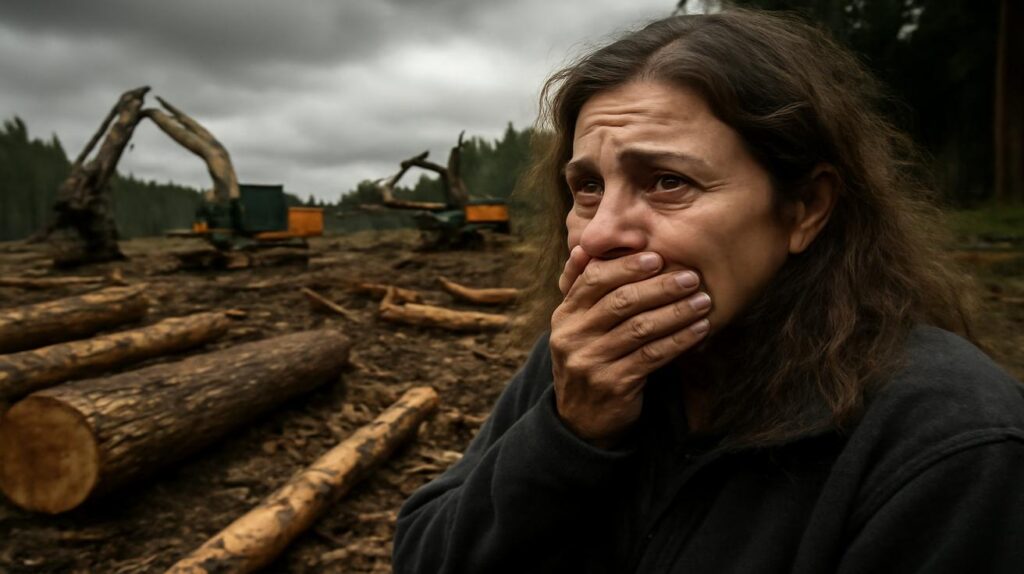
There is a choreography to destruction when it’s done legally and with permits, and watching it is its own kind of trauma. First come the surveys and spray-painted symbols on trunks. Then the smaller trees go, shredded into anonymous woodchips. The old ones, the slow-growing elders that took a century to reach their full height, are toppled with a few bored pulls of a lever. Roots that once gripped soil and held stormwater look obscene and helpless exposed to the air, like organs on a tray.
What surprised me most was the silence of the people watching. A few of us hovered on the sidewalk, hands in pockets, shifting from foot to foot. No one yelled. No one chained themselves to a tree. A neighbor muttered something about traffic getting worse during construction and then corrected himself: “But it’ll be good for the town. They say it’ll bring so much money in.” He said it almost apologetically, as if reciting something he knew he was supposed to believe.
This is the subtle violence of framing environmental loss as a patriotic sacrifice. If you’re upset, you risk sounding naive, ungrateful, anti-progress. So you stand there and swallow the lump in your throat as machines roll over the places where your younger self once felt most free.
The Numbness That Follows
Numbness doesn’t arrive all at once; it seeps in. First, a shrug when you drive by the construction site. Then an uneasy acceptance when the skeleton of the first warehouse rises, all right angles and reflective glass. Then a kind of amnesia: what did it look like here before? Was that hill always gone? Didn’t there used to be—what, exactly?
For a while, you notice every detail: the way the night sky grows paler as parking lot lights burn all hours, the low diesel rumble that seeps through your window at 3 a.m., the way a coating of fine dust settles on your porch. But the remarkable thing about humans is how quickly we can adjust to the intolerable. Give it enough months, and the noise becomes background. The lights become normal. You stop expecting to hear owls.
What’s harder to spot is the parallel dulling inside. People sleep a little worse, breathe a little shallower, feel a little more restless—and they reach for explanations that have nothing to do with the loss of their forest. Work stress, maybe. Too much screen time. Getting older. Meanwhile, the town’s main street empties out as the new logistics economy shunts life to the highway edge: chain coffee, chain hotels, chain restaurants clustering like barnacles on a concrete hull.
You can feel it in conversations at the grocery store: stories narrow to commutes, shipments, shifts. Fewer people talk about gardening, fishing, foraging, the simple joy of walking. Not because those desires vanish, but because the places to fulfill them are shrinking and scattered. Without the forest as a shared reference point, people slowly stop referencing it at all.
The Myth of Inevitable Progress
There’s a line you’ll hear often in towns like mine: “Well, that’s progress.” It’s delivered with a half-shrug, half-sigh, as if we were talking about the weather or the earth’s rotation. Embedded in that phrase is one of the most powerful myths of our time—the idea that the current form of economic expansion is a force of nature rather than a series of human decisions.
We talk as if a logistics hub is the next logical evolutionary step for a forest, the way a sapling becomes a tree. But there is nothing inevitable about the choice to trade a living ecosystem for just-in-time delivery infrastructure. It’s not destiny; it’s policy. It’s zoning meetings and tax abatements and corporate lobbying. It’s the quiet pressure of global supply chains squeezing into local land-use maps.
This myth persists because it’s convenient. If progress is inevitable, then no one is responsible—not the developers, not the officials, not the investors skimming profit from the top. And if no one is responsible, then no one can be held accountable for what is lost. The forest becomes a regrettable but necessary casualty, like collateral damage in a war.
But saying “that’s progress” is like saying “that’s gravity” while you push someone off a roof. Gravity is real; the push was still a choice.
Who Gets to Define “Better”?
The language of improvement is slippery. A “better” economy often means higher throughput: more goods moved, more boxes shipped, more trucks on the road. Measured in that way, yes, the logistics hub is a triumph. The numbers will look wonderful on a quarterly report.
But if you ask people privately what makes a life “better,” the answers shift. Time with family. Clean air. A sense of safety. The ability to walk somewhere soothing without driving an hour first. A childhood where trees outnumber traffic lights. Very few people list “two-day shipping” as their core requirement for a good life.
Still, those quieter values rarely make their way into feasibility studies. You can put a dollar value on speed and efficiency; it’s harder to monetize the feeling of lying on your back in the forest, staring up through layers of leaves while the wind speaks in different dialects of rustling. There is no line on a spreadsheet for the surge of calm that comes from knowing a wild place exists within walking distance, even on days you don’t go there.
So the people who benefit most from the logistics hub point to charts and say, “See? Better.” Meanwhile, those whose kids now play under distant powerlines instead of near a mossy log struggle to articulate what, exactly, has been taken from them in words that count in a legal hearing.
Remembering How to Care Out Loud
What would it look like to interrupt this pattern—to notice, to name, and to resist that slide into numbness? It doesn’t always mean chaining yourself to a tree (though sometimes it might). Often it begins with something simpler and harder: allowing yourself to feel the full weight of what’s being lost and saying it clearly, even when the room is full of spreadsheets and suits.
Imagine a public hearing on a proposed development where, in addition to the usual traffic studies and economic forecasts, people stand and tell stories. A woman describes teaching her son how to identify birds by their calls under those specific branches. An older man talks about cutting through the woods on his way to the factory, how the morning light there kept him going through decades of shift work. A teenager admits that the forest edge behind the school is the only place they feel safe crying.
These are not sentimental extras. They are data about the true value of a place, just as real as acreage and tax revenue. When we bring those stories into decision-making, we’re not being irrational; we’re expanding the definition of rationality to include the well-being of human hearts and bodies, not just balance sheets.
Of course, stories alone won’t stop every bulldozer. But they can change the terms of what feels acceptable. They can push a town toward protecting some parcels as commons instead of carving everything into commercial plots. They can spark conversations about alternative futures: small-scale businesses, community forests, restoration projects, and economies designed for sufficiency rather than endless maximization.
And perhaps most importantly, they can remind us that we are not just consumers of “progress” but participants in shaping it. We are allowed to say, “Not here. Not this forest. Not at the cost of who we are.”
Walking the Edge of What’s Left
Today, the logistics park where my forest once stood is operational. The warehouses wear names you’d recognize from the sides of delivery vans. Trucks idle in long rows, exhaling their breath into mornings that used to smell like wet leaves and soil. Security cameras blink where woodpeckers once nested.
Yet traces remain if you know where to look. At the far edge of the property, where the developers decided a drainage pond and a thin cosmetic buffer of trees would be “good optics,” there’s a narrow strip of the original forest left. It’s not much—an afterthought, really—but moss still spreads there in patient green. Deer tracks pattern the muddy margins. On a recent walk, I found a single trillium emerging by the chain-link fence, its white petals impossibly clean against the rusted metal.
Standing there, I realized two things at once. First: what has been destroyed is irreversible, at least on the scale of my own lifetime. No amount of guilt or nostalgia will bring back the sprawling, intricate community of roots and wings and fur that once thrived here. Second: what remains still matters, perhaps even more fiercely now.
To love a diminished forest is not to let the machines off the hook; it is to refuse the final stage of numbness—the stage where we decide that, because we couldn’t save everything, it’s not worth saving anything. The edge strip, the hidden ravine behind the industrial park, the weedy lot where saplings push through gravel: these may be the scraps of wildness we inherit. How we treat them will say something about whether we’ve learned anything from the loss.
So I visit that thin stand of trees. I bring my coffee and, sometimes, a trash bag. I pick up plastic wrapping and stray zip ties. I listen for the few birds who still dare to sing under the drone of trucks. I tell my nieces stories about how this place used to stretch all the way to the river, how foxes once cut through here at dusk. Their eyes widen. They ask why we let it happen.
I don’t have an answer that feels adequate. But I know this: someday they will stand at some other edge of some other forest, facing some other glossy sign promising progress. Maybe they’ll remember our conversations. Maybe they’ll applaud a little more slowly. Maybe they’ll ask harder questions before the first tree falls.
Frequently Asked Questions
Why do communities often support projects that destroy local forests?
Because these projects are framed as economic lifelines—promising jobs, tax revenue, and “modernization.” In many towns facing unemployment or budget shortfalls, it feels risky to oppose anything labeled as progress. The wider emotional and ecological costs are rarely included in official assessments, so the trade-off looks better on paper than it feels in real life.
Are logistics hubs and similar developments always bad?
Not inherently. Moving goods is part of modern life. The issue is placement, scale, and design. When such hubs replace irreplaceable ecosystems, sit right next to homes, or are approved without serious consideration of alternatives and community well-being, the harm can outweigh the benefits. Thoughtful planning can reduce impacts—but that requires prioritizing more than just profit and speed.
What kinds of alternatives could towns consider instead of forest-to-warehouse development?
Options include protecting forests as community commons, promoting small-scale, locally owned businesses, investing in restoration and eco-tourism, supporting regenerative agriculture, or repurposing already degraded or abandoned industrial land rather than clearing new green spaces. None of these are magic solutions, but together they can build more resilient, place-based economies.
How can individuals push back against destructive “progress” in their town?
You can attend planning and zoning meetings, join or form local conservation groups, share stories and data about the value of local ecosystems, and support candidates who take land-use and environmental justice seriously. Sometimes, simply asking persistent questions—about health impacts, alternatives, and long-term consequences—can slow the rush to approve harmful projects and open space for better ideas.
Is it still worth caring for small, damaged patches of nature after big losses?
Yes. Ecologically, small patches can serve as refuges and corridors for wildlife and as seeds for future restoration. Emotionally and culturally, they keep a thread of relationship to the land alive. Caring for what’s left is both an act of resistance and a way to remember that different choices are still possible, even in a landscape shaped by past mistakes.