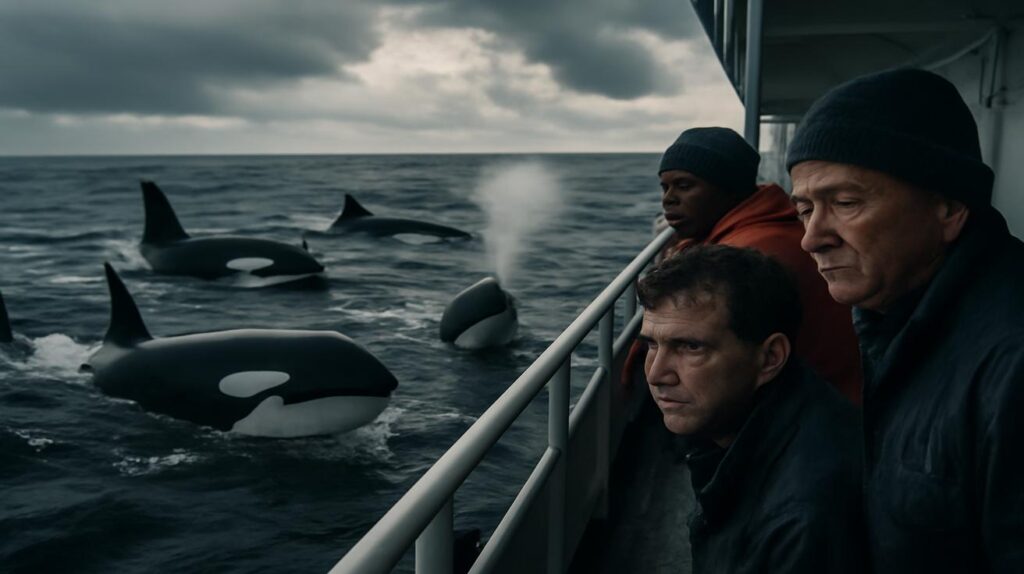
The first thing you notice is the sound. Not the deep, steady hum of engines under a steel hull, not the slap of waves against a cargo ship’s bow, but the wet, explosive exhale of breath from something alive beneath you. The crew leans over the starboard rail, eyes narrowed against the Atlantic glare, scanning for that next flash of black-and-white. Phones are out. Voices are hushed. Somewhere out there, just beyond the shimmer of the surface, a group of orcas is circling the ship like shadows with intent. A radio crackles on the bridge with a warning from another vessel: “Be advised, orcas in the area. Possible interaction.”
When Orcas Meet Steel: A New Story at Sea
For centuries, sailors told stories of monsters at sea—krakens, leviathans, serpents big enough to swallow entire vessels. Today, the stories sound different, but they carry the same tremor of fear and fascination. Off the coasts of Spain, Portugal, and Morocco, pod after pod of orcas has been interacting with, and in some cases damaging, commercial ships and smaller sailing vessels. Rudders are being bitten, shoved, twisted. Boats are left drifting, engines useless, waiting on rescue. Videos ripple across social media: a rudder spinning wildly in the water while sleek black bodies streak past like torpedoes with eyes.
Almost overnight, a new narrative has crystallized online—half joke, half serious. Are these orcas, with their coordinated attacks and apparent focus on disabling key parts of vessels, oceanic terrorists? Or are they, as some environmentalists and armchair philosophers suggest, freedom fighters of the sea, striking back against the steel giants that carve up their world, drown their songs, and chase their prey?
It’s a question that hooks into something deep in us: the need to slot behavior—especially defiance—into a moral frame. We can’t help it. When we see an animal target the machinery of power, we reach for human words.
The Strange Case of the Rudder-Biting Orcas
Imagine you’re standing on the stern of a 40-foot sailboat somewhere off the Spanish coast. Wind in the rigging, the soft thrum of water along the hull. Then—bang. The boat shudders like it’s hit a submerged log. Another impact, sharper, from below. Someone yells. When you look down, you see them: orcas, massive and deliberate, pressing against your rudder, biting and twisting as though they’ve found a loose tooth in the body of your boat and are determined to rip it out.
These encounters are not random bumps. They’re focused, sometimes repeated, sometimes ending only when the rudder is entirely destroyed. The behavior has been reported mostly in a specific group of orcas off the Iberian Peninsula. Within this group, it seems to spread socially, passing from individual to individual like a new game—or a new tactic.
The thing about orcas is that they’re experts at intention. They’re apex predators with sophisticated problem-solving skills, family-based cultures, and learned hunting traditions. They coordinate to knock seals off ice floes, teach their young to tail-slap fish into stun, and can mimic each other’s innovations with eerie speed. When that same capacity turns its attention to boats, it feels less like random curiosity and more like strategy—and that makes humans nervous.
The Human Need to Label the Uncomfortable
Faced with this unnerving pattern, our language lurches into metaphor. Attack. Aggression. Sabotage. Terrorism. Freedom fighting. We pick sides without admitting we’re doing it. On social media, it’s all memes of orcas in balaclavas or revolutionary hats, slogans about “Eat the rich, sink the yachts,” and cheering when videos surface of damaged rudders trailing bubbles and splinters. In other corners, there’s real worry, even anger: shipping disruptions, safety fears for crew, the potential for serious accidents.
It’s tempting, almost irresistible, to see the orcas as moral actors in a human drama. They’re either heroes striking back at the industrial assault on the ocean, or they’re villains attacking innocent mariners. But both of those roles are things we put on them like costumes. The orcas, meanwhile, are busy being orcas.
Are They Really “At War” with Ships?
To call orcas “terrorists” suggests a political motive: a deliberate campaign to spread fear, to send a message, to change human behavior through violence. To call them “freedom fighters” implies a similar motive, just with a moral flip: resisting oppression, struggling toward a better world for their kind. The problem is that both of these are human categories, built out of our history and our particular flavor of consciousness. We don’t actually know what it feels like to be an orca—and we certainly don’t have evidence they’re reading policy reports on shipping emissions or fish stock depletion.
What we do know is this: orcas are highly social, playful, and culturally complex animals. Many of their behaviors—from unique vocal dialects to preferred hunting methods—vary between pods and can be culturally transmitted. That means a single individual’s innovation, whether it’s a new hunting trick or a strange fascination with boat rudders, can spread through the group.
Some scientists speculate that one or more orcas in these Iberian pods had a negative interaction with a vessel—perhaps an injury from a collision, or a terrifying close pass—and that the resulting trauma translated into this focused attention on rudders. Others suggest a more benign origin: that it might have begun as a form of play or curiosity that escalated. Either way, it travels through the pod like a story.
But here’s where it gets tricky. Just because orcas aren’t “political” in our sense doesn’t mean their actions don’t have meaning. To them, disabling a rudder may be a satisfying, socially reinforcing behavior with emotional weight. The sea is not neutral ground; it’s their home. The ships are intruders that roar, loom, and vibrate through their soundscape, slicing migration routes and altering prey patterns. Whether or not orcas conceive of this as injustice, they are undeniably living inside its consequences.
Why the “Terrorist” Label Misses the Mark
“Terrorist” is a heavy word. It carries with it decades of fear, war, and the justification of harsh countermeasures. The moment we place an animal in that category, we invite a certain kind of response: control, suppression, retaliation. It nudges us closer to viewing a wild creature not as a fellow being, but as a threat that must be neutralized.
Yet when you strip away the rhetoric, what are the orcas doing? They’re targeting equipment, not people. They’re almost eerie in their focus on the machinery of motion rather than the soft, flailing bodies of crew on deck. Plenty of boats have been damaged; people have been frightened, shaken, occasionally injured in the aftermath—but these are side effects, not the direct target of the orcas’ attention.
If this were a human resistance group, we’d call that a kind of tactical precision. In animals, it looks like specialized behavior honed by experience. It doesn’t fit neatly into the “random aggression” box, nor does it sit comfortably in the “evil terrorist” category.
Are They Freedom Fighters of the Sea?
The other story, the one that often gets a wink and a cheer online, paints the orcas as oceanic rebels. In this version, they’re striking back against a global shipping industry that burns fuel by the ton, floods their world with noise, and competes with them for dwindling fish. Orcas take out a rudder, the internet raises a glass. “Good,” some people say. “About time someone fought back.”
There’s something deeply human in that reaction, too. We’re used to stories of uprising: oppressed groups standing up to empires, marginalized voices refusing to stay quiet. It feels right, almost cinematic, to cast the orcas in this role. Black-and-white warriors taking aim at the hulking silhouettes that have carved ruts through their blue country.
But again, this is our narrative laid over their behavior. Orcas didn’t sign manifestos. They didn’t hold a pod council and agree on an anti-ship political platform. They’re reacting to a world shaped by human activity, no question—but whether that’s “rebellion” in a conscious sense is something we can’t honestly claim to know.
Symbol, Yes. Soldier, No.
Where the “freedom fighter” label does hold power is in the symbolic realm. Regardless of their intentions, the orcas’ actions feel like a mirror held up to us. Here is a creature we cannot easily dismiss as mindless, one that moves through the same waters our ships traverse with a kind of indigenous authority. When such a being begins to disable our vessels, it forces a crack in our comfortable belief that we own the sea.
In that sense, the orcas become emblematic—symbols of a livelier, more resistant ocean than we prefer to imagine. They expose the tension at the heart of the blue planet: our dependence on shipping and trade versus the quiet, often invisible lives that these steel corridors disrupt. The orcas aren’t freedom fighters in the way we use the term for human struggles, but they are, undeniably, voices—nonverbal, assertive—reminding us that the sea is not only a highway. It’s home.
What’s Really at Stake Beneath the Debate
Behind the memes and the moralizing, something more practical pulses: safety, economics, and the future of coexistence with a thriving apex predator in heavily trafficked waters.
| Perspective | Main Concern | How They See the Orcas |
|---|---|---|
| Commercial Shipping Companies | Damage to vessels, delays, crew safety, insurance costs | Unpredictable risk that must be managed |
| Sailors & Yachters | Personal safety, potential loss of boat or life at sea | Awe-inspiring but frightening neighbors |
| Marine Biologists | Understanding the behavior, preventing escalation, protecting the pod | Intelligent animals expressing culture and stress |
| Environmental Advocates | Highlighting ocean impacts from shipping and fishing | Living symbols of ecological pushback |
Different groups carry different fears and hopes into this story. A shipping firm sees potential accidents, lawsuits, and expensive rerouting. Crew members see the terrifying reality of losing steering in heavy seas. Scientists see a fragile, culturally rich population of orcas that could suffer if public opinion turns and governments decide on aggressive “solutions.” Activists see an opportunity to talk about noise pollution, overfishing, and climate change in language people can’t ignore.
At the center of all this is a simple, stubborn question: how do we share the sea with other intelligent beings whose needs often conflict with our habits?
Coexistence, Not War
Some responses are already emerging. Ships are being advised to slow down or alter course when orcas are reported nearby. Guidelines suggest powering down engines, avoiding sudden maneuvers, and not reacting aggressively if orcas begin to interact with the boat. Researchers are experimenting—with caution—with non-harmful deterrents, like specific sounds, though there’s concern about adding yet more noise to an already loud ocean.
These are small steps, but they point away from a combative mindset. Instead of framing the orcas as enemies, they treat them as powerful, unpredictable neighbors whose presence demands respect and adaptation. It’s less about victory and more about negotiation—albeit one conducted without shared language.
If there is a lesson in the rudder-biting saga, it may be that coexistence with wild intelligence is messier than we’d like. It won’t always be a postcard of dolphins bow-riding at sunset. Sometimes, it will look like damage reports and nervous voices on maritime radio channels. And yet, in that tension, there’s an opportunity to rethink what “dominion over the seas” really means.
Beyond Terrorists and Freedom Fighters: A Different Story to Tell
Standing at the rail of a ship with orcas below is an unsettling experience. They’re close enough that you can see the white flash of their eye patch, the slick curve of their dorsal fin, the easy confidence in the way they glide and pivot. These are not background animals, not distant seabirds wheeling over the wake. They feel like presences—watching, choosing, deciding.
Calling them terrorists is a way of pushing back, of putting them in a box where human power still feels justified and unquestioned. Calling them freedom fighters is a way of romanticizing the same conflict, soothing our guilt with a story that at least frames the orcas as righteous. But there’s another path: to see them as what they are—apex predators in a damaged world, responding with the full force of their intelligence and culture to the strange, thunderous machines that have invaded their realm.
In that version of the story, we don’t need them to be heroes or villains. We can let them be complicated, as tangled in the consequences of our choices as we are. We can admit that a shipping lane is not just a line on a map; it’s a corridor of contested space, running through someone else’s living room.
Maybe, years from now, the rudder-biting behavior will fade, replaced by some new cultural quirk: a novel hunting technique, a fresh game passed among calves. Marine biologists will write papers; sailors will tell stories in harbor bars about “the orca years” when you never quite relaxed at the helm. But the deeper question these encounters raise will linger, humming under the surface like engine noise.
How do we move through this world—its oceans, forests, skies—without insisting that every other creature fit into our moral scripts? Can we accept that some beings will resist us not out of ideology, but simply because our presence hurts them, frightens them, or disrupts the patterns of their ancient lives?
The next time a video floats across your screen of orcas spinning a disabled rudder in clear blue water, you might still laugh, or wince, or feel a twist of fear. But perhaps, instead of asking whether they’re terrorists or freedom fighters, another question can rise: what kind of species have we been, to them, to bring us to this moment?
On the open sea, with nothing but water in every direction and a sky so wide it erases your sense of scale, it’s easy to imagine we’re alone in our decisions. The orcas remind us we are not. They are not terrorists. They are not soldiers. They are something far more unsettling and wondrous: a nation of minds beneath the waves, living under the pressure of our choices, sometimes pushing back in ways we never expected.
Frequently Asked Questions
Are orcas intentionally attacking ships?
Orcas are deliberately interacting with ships, often focusing on rudders, but we do not have evidence that they understand this as an “attack” in the human, political sense. It appears to be a learned behavior within certain pods, possibly driven by curiosity, play, stress, or past negative experiences with vessels.
Have people been killed by these orca interactions with boats?
Reports of orcas damaging rudders and hulls have led to dangerous situations at sea, but there are no verified cases of orcas deliberately harming or killing people in these incidents. The main risks are loss of steering, capsizing in rough conditions, or delayed rescue.
Are these orcas considered endangered?
Many orca populations worldwide are threatened or vulnerable due to pollution, declining prey, noise, and habitat disruption. The specific Iberian orcas involved in most rudder incidents are a small, fragile population of particular conservation concern.
Can ships legally harm orcas to protect themselves?
In most jurisdictions, orcas are protected by law, and deliberately harming them is illegal. Maritime guidelines encourage non-lethal responses, such as slowing down, changing course, and avoiding behaviors that could escalate interactions.
What can be done to reduce these encounters?
Possible measures include route adjustments to avoid key orca areas, speed reductions, better real-time reporting of orca presence, and further research into non-harmful deterrents. Long term, addressing noise pollution and the broader ecological pressures on orcas may reduce stress-driven behaviors.
Why do people call them “freedom fighters” or “terrorists” of the sea?
These labels reflect human attempts to interpret and dramatize orca behavior. “Terrorist” emphasizes fear and risk, while “freedom fighter” highlights a sense of moral retaliation against human impacts on the ocean. Both are metaphors that say more about us than about the orcas themselves.
How should we think about orcas in this debate?
Rather than forcing them into human roles, it’s more accurate and respectful to see orcas as intelligent, culturally rich animals responding to a rapidly changing environment. Their interactions with ships are a signal that our use of the sea has real, sometimes surprising consequences for the lives already unfolding there.